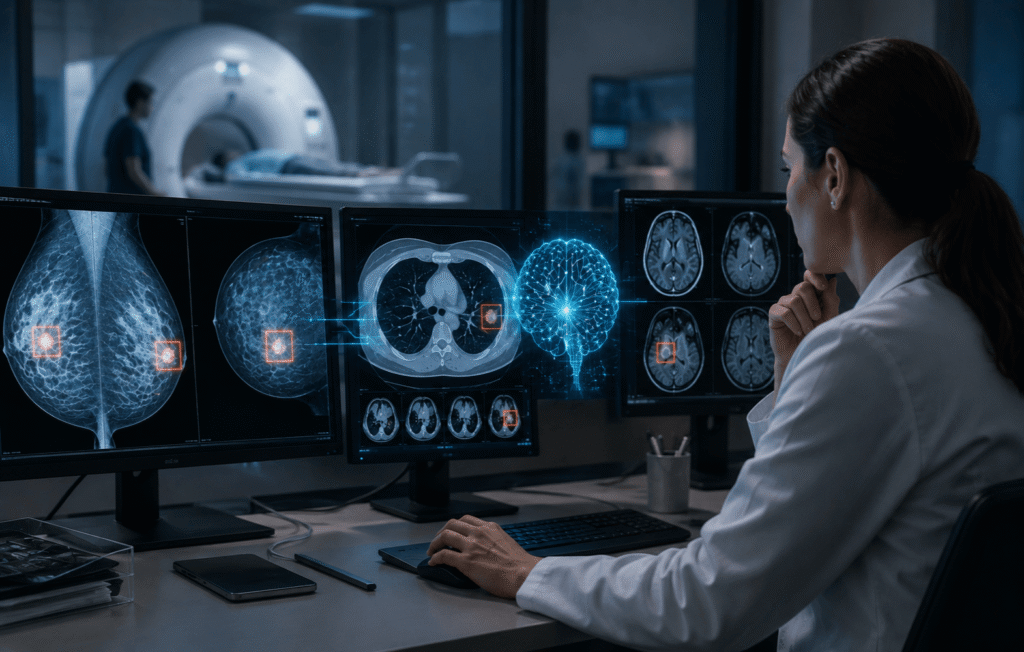
Medical imaging generates far more scans every year than radiologists have time to review as carefully as they would like, which creates a real, quiet risk that something subtle gets missed on a busy day. Machine learning models trained on millions of prior images have started closing that gap, not by replacing the specialist reading a scan, but by flagging patterns a tired human eye can overlook, and by working through the review queue faster so urgent cases get seen sooner.
Where the evidence is strongest
Screening for conditions with a clear, well documented visual pattern, certain cancers on a mammogram, diabetic retinopathy on a retinal scan, has produced some of the most consistent results, because these are exactly the kind of pattern recognition tasks machine learning handles well when given enough labeled training examples. Several AI assisted screening tools have received regulatory clearance specifically as a second reader, flagging cases for a specialist to review more closely rather than issuing a diagnosis on their own, which keeps a human decision maker in the loop for anything that actually changes patient care.
Catching what gets missed on a first pass
Studies comparing radiologists working with an AI assistant against radiologists working alone have generally found the assisted group catches a meaningfully higher share of early stage findings, particularly small or subtle ones that are easy to overlook among a stack of routine, normal scans. The tool does not need to outperform a specialist outright to be valuable; it only needs to reliably flag the small number of cases in a large batch where something looks different from the pattern the model was trained on, which is exactly the kind of tedious, high volume task that benefits from a second, tireless reviewer.
The limits that still matter
A model trained mostly on images from one type of scanner, one population, or one hospital system can perform noticeably worse on patients or equipment it was not trained on, which is why regulators and hospitals have pushed for testing across diverse patient populations before a tool goes into wide clinical use. These systems also tend to be narrow specialists themselves, a model trained to spot one condition on one type of scan generally cannot be repurposed to catch an unrelated condition without retraining, unlike a human doctor who can apply broader judgment across an unfamiliar case.
What patients should take from this
For a patient, the practical impact of this shift is mostly invisible, a scan gets read with an extra layer of computerized review before a specialist finalizes the result, rather than a machine making a diagnosis directly. The technology is best understood as raising the floor on screening quality and catching cases that might otherwise wait for a follow up scan to be noticed, not as a replacement for the physician who ultimately explains a result and decides what happens next.