
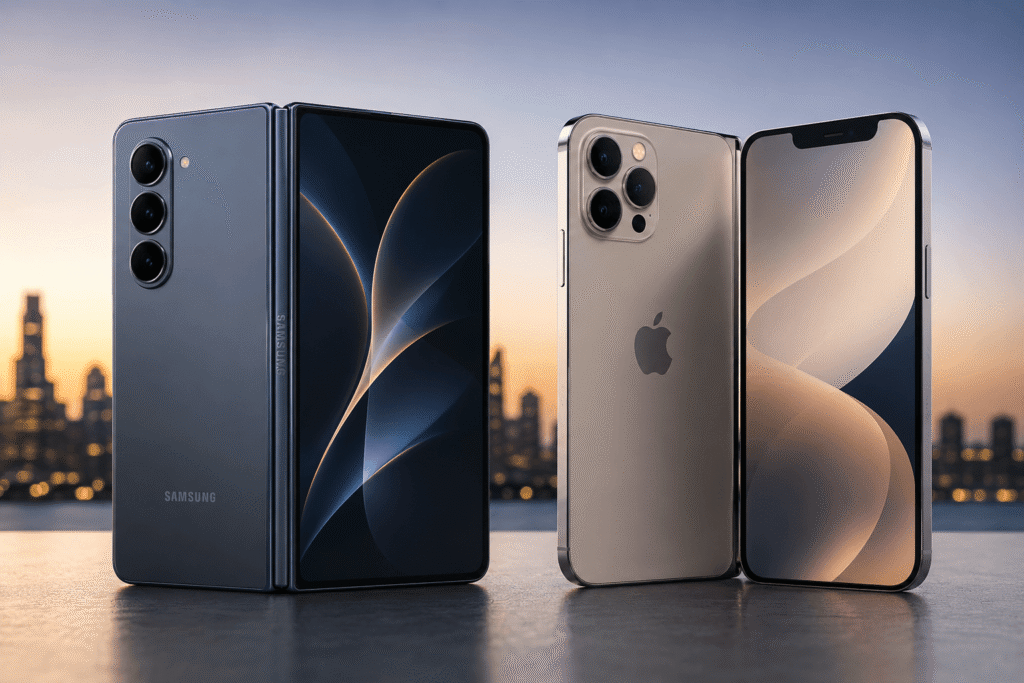
Samsung’s Galaxy Z Fold 8 lineup officially went on sale August 7, 2026, and for the first time, the company split its flagship foldable into two distinct phones rather than one. Weeks later, Apple is set to answer back. The company’s long-rumored foldable iPhone, widely expected to be called the iPhone Ultra, is tipped to debut at Apple’s September 9 event. After nearly a decade of leaks and false starts, 2026 looks like the year foldable phones finally become a fight between the industry’s two biggest smartphone makers rather than a Samsung-only category.
Why This Is Trending Now
Foldable phones have existed since 2019, but they have mostly remained a Samsung-dominated niche. That changes if Apple actually ships a foldable iPhone this fall, since Apple’s entry tends to legitimize a product category for mainstream buyers in a way competitors alone cannot. Samsung’s decision to launch two different Fold shapes at once, just weeks before Apple’s expected reveal, reads as a deliberate move to plant its flag in the category before Apple arrives.
What Happened?
Samsung unveiled the Galaxy Z Fold 8 lineup at a Galaxy Unpacked event held in London on July 22, 2026, its first summer Unpacked event held in the UK. Alongside the Galaxy Z Flip 8, Galaxy Watch 9 series, and Galaxy Glasses, Samsung introduced two distinct large foldables for the first time: the Galaxy Z Fold 8 Ultra, the direct successor to last year’s Fold 7, and a new Galaxy Z Fold 8 “Wide” variant with a shorter, wider 4:3 inner display designed to feel more like a small tablet. Pricing starts at $1,899 for the Z Fold 8 and $2,099 for the Fold 8 Ultra, making this Samsung’s most expensive foldable generation yet. Both phones went on sale August 7, 2026, running Android 17 with Samsung’s One UI 9 and a promised seven years of software updates.
What It Means for the Industry
Samsung’s decision to split its Fold lineup into two shapes signals that the company sees enough demand to segment the foldable market the way it already segments its Galaxy S line into standard, Plus, and Ultra tiers. That matters because Apple is reportedly taking the opposite approach for its debut: a single foldable model, expected to be called the iPhone Ultra, with a passport-style design featuring a roughly 7.7 to 7.8-inch inner display and a smaller cover screen. Apple’s rumored device is said to prioritize a crease-free hinge, a persistent complaint about foldable phones generally, even if that means trade-offs elsewhere, such as reports that the device may ship without Face ID or a telephoto camera.
How It Could Affect Businesses and Consumers
For consumers already invested in foldables, the arrival of a credible Apple competitor could push both companies to improve durability, battery life, and app support faster than they might have otherwise. For app developers, Apple has reportedly begun emphasizing what it calls “app adaptability” at its 2026 developer conference, a signal that supporting wildly different screen sizes on a single device is about to become a mainstream requirement rather than a niche concern limited to Android foldable owners. For everyday buyers, though, price remains the biggest barrier: with Samsung’s cheapest new Fold starting near $1,900 and Apple’s rumored foldable expected in a similar $1,999 to $2,399 range, foldables remain solidly in ultra-premium territory rather than mass-market devices.
Key Benefits and Opportunities
Competition between Samsung and Apple in the same category has historically driven faster innovation and eventually lower prices across the wider smartphone market, and analysts expect a similar dynamic here. Samsung’s Wide variant, with its shorter and wider profile, targets buyers who found earlier book-style folds too narrow and cramped when closed, while Apple’s rumored crease-free hinge, if it delivers on the promise, could address the single most common complaint reviewers have raised about foldables since the category began. A genuine two-way race could also accelerate supply chain investment in flexible display technology, potentially bringing costs down for smaller and mid-range foldables over the next few product cycles.
Risks and Challenges
Apple’s foldable has faced a long history of delayed timelines, with rumors dating back to 2017 and predicted launch years slipping repeatedly from 2020 through 2025. Even with a September 2026 event reportedly confirmed, supply chain reports indicate mass production was pushed back from June to August 2026, and some analysts have warned that manufacturing complexity could cause supply shortages extending into 2027. Component costs are also rising industry-wide; a global DRAM shortage has already pushed up prices on higher-storage configurations across the smartphone market, a pressure that is likely to keep foldable prices elevated regardless of which company builds them. For Samsung, meanwhile, splitting its lineup into two Fold shapes risks diluting a category that is still a small fraction of overall smartphone sales.
What Experts, Companies, or Regulators Are Saying
Industry coverage of Apple’s rumored launch has framed it as a potential turning point for a product category that has stayed niche for nearly a decade. Tom’s Guide described the moment as one that could push foldables closer to the mainstream and put Samsung’s long-held dominance of the category at risk. Samsung has not publicly commented on Apple’s rumored device, and Apple, following its usual practice, has not confirmed the iPhone Ultra’s existence ahead of its scheduled September 9 event.
What Happens Next?
All eyes now turn to Apple’s September 9 event, where the company is widely expected to unveil its first foldable alongside the iPhone 18 Pro and iPhone 18 Pro Max. If supply chain reports about production delays hold true, initial stock could be constrained well into 2027, which would blunt the immediate competitive pressure on Samsung even if Apple’s device is well received. Samsung, for its part, is likely to use the months following Apple’s reveal to gauge how its two-shape Fold strategy performed before deciding whether to keep both variants in future generations.
Conclusion
Samsung has effectively had the premium foldable market to itself for years, and its answer to that advantage has been to split its own lineup rather than wait for competition to arrive. Whether that turns out to be smart positioning or a hedge born of anxiety may depend entirely on what Apple actually ships this September. Either way, foldable phones are about to get a lot more attention than they have in years, and buyers weighing an upgrade may want to see what Apple reveals before committing nearly $2,000 to Samsung’s latest bet.