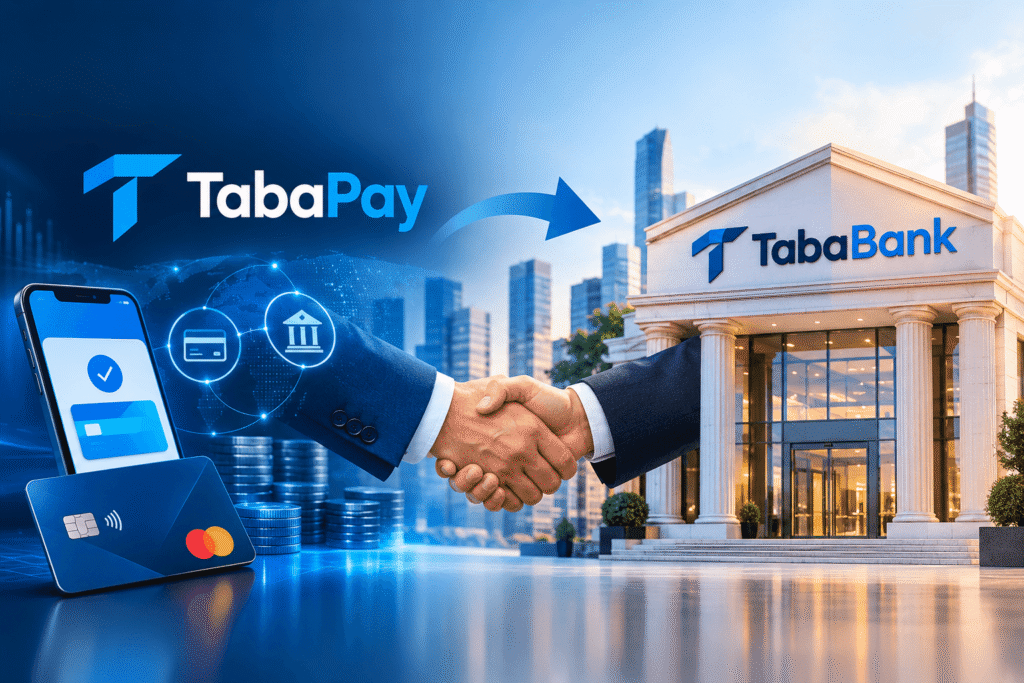
Payments infrastructure company TabaPay announced on September 2, 2026, that it has raised $155 million in strategic growth financing led by FTV Capital and plans to acquire Transact Bank, a Denver-based, OCC-chartered and FDIC-insured bank. Once the deal closes, Transact Bank will be rebranded TabaBank, N.A., giving TabaPay its own banking charter for the first time.
The move marks a significant strategic shift for TabaPay, which has historically operated as a payments technology layer relying on partner banks, rather than as a directly chartered banking institution.
What Happened? TabaPay’s Funding and Acquisition Explained
The $155 million financing round combines new primary capital for TabaPay with a secondary share transaction, and represents the first institutional investment figure the company has publicly disclosed. TabaPay had previously received investment from SoftBank Vision Fund 2 in 2022, though that amount was never made public. As part of the new round, FTV Capital partner Robert Anderson has joined TabaPay’s board of directors.
The capital raised will directly fund TabaPay’s planned acquisition of Transact Bank, which is expected to close in the fourth quarter of 2026, subject to regulatory approval from the OCC and the Federal Reserve. Once complete, Transact Bank will be renamed TabaBank, N.A., and will operate alongside TabaPay under a newly registered bank holding company called TabaHoldings.
Transact Bank itself has an interesting history: it was previously known as Colorado National Bank before being rescued from administration in 2018 by Transact Pro founders Mark Moskvin and Maxim Yaroshewsky for $9 million. Following a further $2 million capital injection and a Fiserv systems migration, the bank was rebranded Transact Bank and refocused entirely on card issuing and acquiring infrastructure for domestic and cross-border businesses — a specialty that aligns closely with TabaPay’s existing payments business.
Why It Matters
TabaPay operates money movement infrastructure for fintech companies, lenders, and other platforms through a single API spanning card and bank payment rails, and says its platform can reduce customers’ payment costs by as much as 75%. The company works with more than 20 partner banks across the US and Canada, serves roughly one-third of US households indirectly, and expects to process more than $100 billion in payment volume during 2026. It also ranks as the fifth-largest card-not-present processor in the US by transaction count.
Acquiring its own bank charter would let TabaPay reduce its reliance on that network of partner banks for certain regulated banking functions, giving it more direct control over the infrastructure underpinning its payments platform. Industry analysts have noted that this kind of vertical integration — combining payments technology with a proprietary banking charter — addresses a structural challenge many fintechs face: needing multiple sponsor banks to support a wide range of use cases, which can add operational complexity and create redundancy risk as regulatory requirements evolve over time.
This is not TabaPay’s first attempt to acquire a distressed or bank-adjacent asset. In 2024, the company made headlines with a $9.7 million offer to acquire the assets of fintech middleware provider Synapse shortly after it filed for bankruptcy. That deal ultimately fell apart when TabaPay terminated the agreement after Synapse’s banking partner, Evolve Bank & Trust, failed to fully fund certain customer accounts as required under the purchase agreement’s closing conditions.
How It Works: What TabaBank Will Offer
Once operational, TabaBank is expected to support major money movement rails including RTP (Real-Time Payments), FedNow, ACH, and wire transfers, alongside card sponsorship across Visa, Mastercard, Discover, and regional card networks. TabaPay has also said the new bank will support digital banking and debt repayment use cases, in addition to acting as a payment acquirer across multiple industries and major card networks.
The $155 million investment is also intended to support TabaPay’s broader product roadmap, including merchant liquidity products and potential future strategic acquisitions, according to the company.
Key Benefits
Reduced dependency on partner banks: Owning a chartered bank gives TabaPay more direct control over regulated banking functions currently handled by its network of 20-plus partner banks.
Broader product capabilities: A proprietary bank charter would let TabaPay expand into digital banking, lending, and acquiring services beyond its current payments infrastructure focus.
Vertical integration: Combining payments technology and banking under one holding company, TabaHoldings, could streamline operations and potentially improve margins over time.
Institutional backing: FTV Capital’s lead investment and board seat brings new institutional credibility and growth capital to support TabaPay’s expansion plans.
Risks and Challenges
The acquisition still requires approval from both the OCC and the Federal Reserve, and bank acquisitions of this kind can face extended regulatory review, particularly when a non-bank fintech company is acquiring a chartered institution. TabaPay’s own history with the failed Synapse deal in 2024 is a reminder that bank-related acquisitions in the fintech space do not always close as planned, even after terms are announced.
There is also integration risk. Combining a payments technology company’s operations with a small community bank’s existing infrastructure, staff, and regulatory obligations is a complex undertaking, and past mergers of this type have sometimes taken longer or proven more difficult than initially expected.
Additionally, becoming a chartered bank brings TabaPay under a new level of direct regulatory supervision it has not previously operated under as a payments technology provider, which could introduce compliance costs and operational changes as the company transitions into its expanded role.
What It Means for Businesses and Consumers
For TabaPay’s existing fintech, lender, and platform customers, the acquisition could eventually mean more integrated banking and payment services delivered through a single relationship, rather than needing to coordinate across TabaPay and separate partner banks. For the broader fintech industry, the deal illustrates a continuing trend: payments companies increasingly view owning a bank charter as a strategic advantage rather than an unnecessary regulatory burden.
For consumers, the effects will likely be indirect, felt primarily through the fintech apps, lenders, and platforms that rely on TabaPay’s infrastructure — potentially through faster settlement times or lower processing costs passed down from TabaPay’s more integrated banking and payments stack.
What Happens Next?
The Transact Bank acquisition is expected to close in the fourth quarter of 2026, pending regulatory approval from the OCC and the Federal Reserve. Once finalized, Transact Bank will be rebranded TabaBank, N.A., and TabaPay will begin integrating banking operations under its new TabaHoldings structure.
Key Takeaways
TabaPay raised $155 million in a round led by FTV Capital, its first publicly disclosed institutional investment figure.
The company plans to acquire Denver-based Transact Bank, which will be renamed TabaBank, N.A. after the deal closes.
The acquisition is expected to close in Q4 2026, subject to OCC and Federal Reserve approval.
TabaPay processes payments for roughly one-third of US households and expects over $100 billion in payment volume in 2026.
The deal follows TabaPay’s earlier, unsuccessful 2024 attempt to acquire assets from bankrupt fintech middleware provider Synapse.
TabaPay’s move to acquire its own bank charter through Transact Bank reflects a broader shift among fintech payment companies toward vertical integration — owning the regulated banking infrastructure that once required multiple third-party partnerships. If the acquisition closes as planned in the fourth quarter, TabaBank would give TabaPay a more direct, streamlined path to delivering both payments and banking services under one roof.