Information technology touches nearly every part of modern life, yet the term itself is often used loosely — sometimes meaning “computers,” sometimes meaning an entire academic degree, sometimes meaning a career path. This guide untangles all of it: what IT actually is, how it differs from computer science, what health information technology means, how IT management works, which IT careers pay the most, and what degree options actually lead somewhere.
What Is Information Technology?
Information technology (IT) is the use of computers, networks, software and other digital infrastructure to create, process, store, secure and exchange electronic data. In practice, IT covers everything from the laptop on your desk and the Wi-Fi router in your home to the servers running a hospital’s patient records and the cybersecurity systems protecting a bank. The field is generally split into hardware, software, networking, data management and cybersecurity, and it exists to help organisations and individuals use information effectively and safely.
Information Technology at a Glance
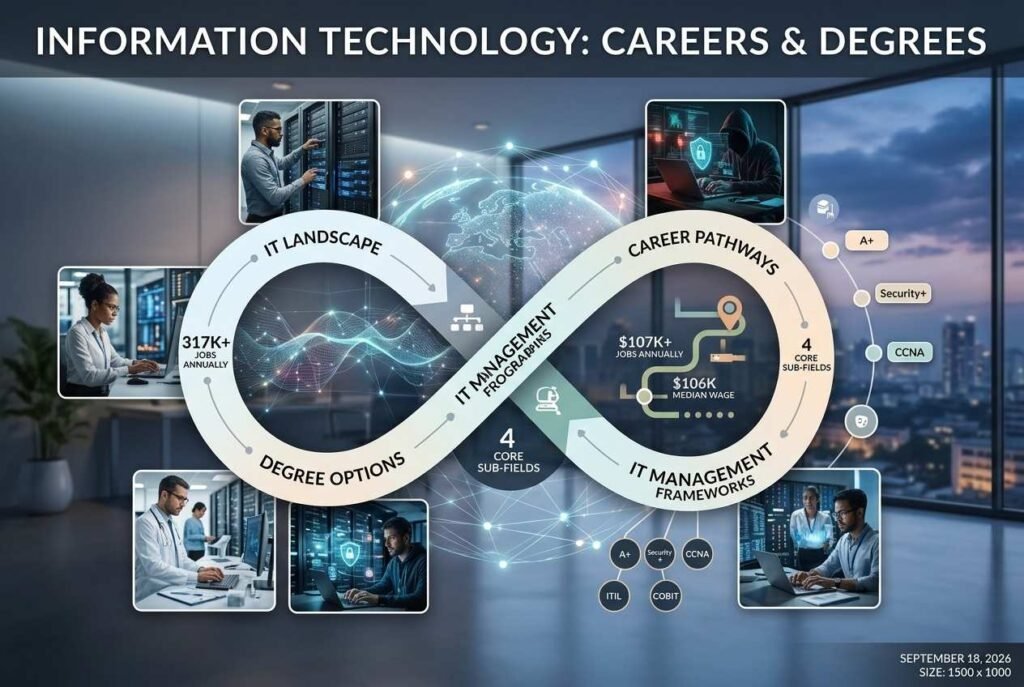
| Field size (US) | Median annual wage $105,990 (May 2024) across the occupation group |
| Job growth (2024–2034) | Much faster than average; roughly 317,700 openings projected per year |
| Typical entry education | Bachelor’s degree (many roles); associate degree or certification for support roles |
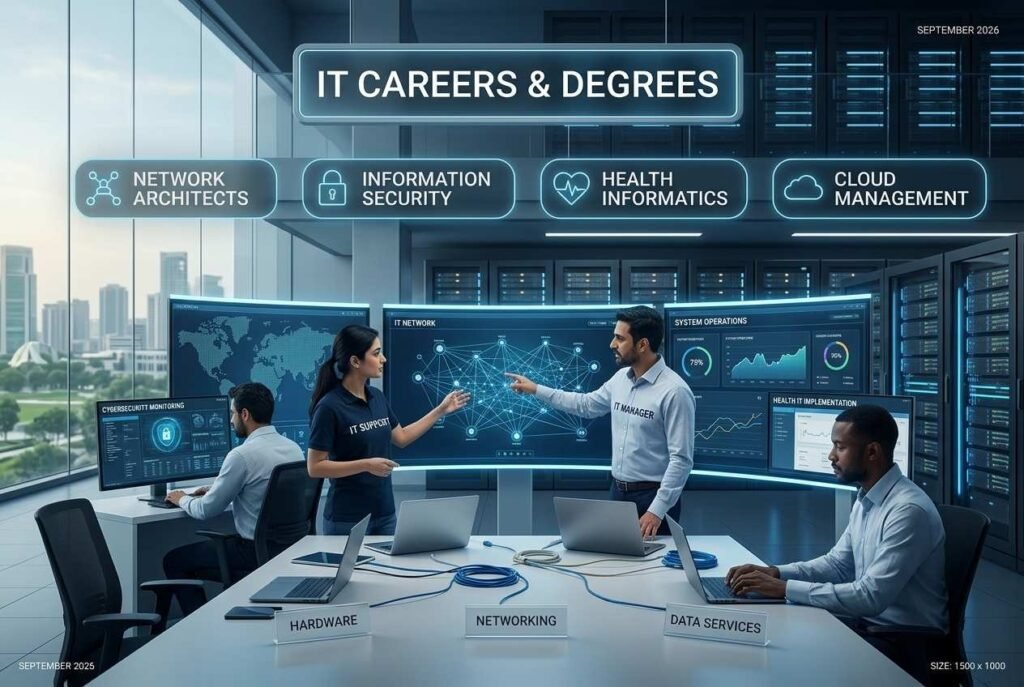
| Core sub-fields | Networking, cybersecurity, software development, data/database management, IT support, health IT |
| Fastest-growing IT role | Information security analyst (29% projected growth, 2024–2034) |
| Related but distinct field | Computer science (theory and design of computing) vs. IT (applying computing to organisational needs) |
What Is Information Technology, Exactly?
The most common definition of information technology describes it as the application of computers, storage, networking and other physical devices, infrastructure and processes to create, process, store, secure and exchange all forms of electronic data. That is a broad definition on purpose — IT is not one skill but an umbrella covering several distinct disciplines that happen to share the same underlying infrastructure.
A useful way to think about it: IT is the plumbing and wiring of the digital world. Software applications are what people see and use; IT is what keeps the applications running, the data safe, the network connected and the systems talking to each other correctly.
The Core Components of IT
- Hardware — physical equipment: servers, computers, storage devices, networking equipment, data centres.
- Software — operating systems, business applications, enterprise platforms, and the code that runs on hardware.
- Networking — the systems that connect devices and let data move between them, from office LANs to global internet infrastructure.
- Data management — databases, data warehouses and the systems that store, organise and retrieve information at scale.
- Cybersecurity — the practices and technologies that protect systems and data from unauthorised access, breaches and attacks.
- IT support and operations — the people and processes that keep everything running day to day, from help desks to system administrators.
Information Technology vs. Computer Science vs. ICT
These three terms get confused constantly, and the distinction actually matters for anyone choosing a degree or a career.
| Field | Focus | Typical question it answers |
|---|---|---|
| Computer Science | Theory, algorithms, software design, computing foundations | How do we build a new algorithm or programming language? |
| Information Technology | Applying and maintaining computing systems for organisations | How do we keep this company’s network, systems and data running securely? |
| Information and Communication Technology (ICT) | IT plus communication systems — telecom, broadcasting, the internet as infrastructure | How do information systems and communication networks work together at a societal or national level? |
Information and communication technology is the term most often used in government, international development and education policy contexts, because it explicitly folds in telecommunications alongside computing — think mobile networks, broadcasting and internet infrastructure, not just office computer systems. Computer science, by contrast, is more theoretical and mathematical, training people to build the systems that IT professionals then deploy, secure and maintain.

A Brief History of Information Technology
Understanding where the term came from helps explain why it means so many things today. The phrase “information technology” entered common business usage in the 1950s and 1960s, as companies began using mainframe computers to process business data rather than only for scientific and military calculation. Through the 1980s and 1990s, the arrival of personal computers, local networks and eventually the internet transformed IT from a specialised back-office function into something every department in every organisation depends on.
The 2000s and 2010s added cloud computing, mobile computing and big data to the field’s responsibilities. The current era, defined by artificial intelligence, cybersecurity threats at scale and hybrid work, has made IT less about “keeping the computers on” and more about strategic infrastructure that determines whether an organisation can compete at all.
Health Information Technology Explained
Health information technology (health IT) is the application of information technology specifically to healthcare — the systems that manage patient records, coordinate care between providers, and secure some of the most sensitive personal data that exists. It is one of the fastest-growing and most consequential sub-fields of IT, precisely because the stakes of getting it wrong are so high.
What Health IT Actually Covers
- Electronic Health Records (EHR) — digital versions of a patient’s paper chart, accessible across authorised providers.
- Health Information Exchange (HIE) — systems that let hospitals, clinics and pharmacies share patient data securely and in real time.
- Telehealth infrastructure — the platforms enabling remote consultations, remote monitoring and virtual care.
- Clinical decision support systems — software that helps clinicians make evidence-based decisions at the point of care.
- Healthcare cybersecurity — protecting patient data under regulatory frameworks such as HIPAA in the United States.
- Medical billing and coding systems — the IT infrastructure behind insurance claims and healthcare administration.
Health Information Technology Careers
Health IT sits at the intersection of two in-demand fields, which is part of why it commands strong salaries. Common roles include health informatics specialist, clinical systems analyst, EHR implementation specialist, healthcare data analyst and health IT security analyst. Most entry points require a bachelor’s degree, often in health information management, health informatics or a general information technology programme with a healthcare focus. Certification bodies such as AHIMA (American Health Information Management Association) offer credentials — including the Registered Health Information Administrator (RHIA) and Registered Health Information Technician (RHIT) — that are widely recognised by employers in this niche.
For readers weighing this path against general IT, the practical difference is domain knowledge: health IT professionals need to understand clinical workflows and healthcare regulation on top of standard IT skills, which narrows the applicant pool and tends to support stronger compensation relative to entry-level general IT roles.
Information Technology Management
Information technology management is the discipline of planning, organising, and overseeing an organisation’s IT resources — its systems, infrastructure, staff and budget — to meet business goals. Where a systems administrator keeps servers running today, an IT manager decides which servers the organisation should be running next year, how much to spend on them, and how to staff the team that supports them.
What IT Managers Actually Do
- Setting technology strategy aligned to overall business objectives
- Managing IT budgets, vendor contracts and software licensing
- Overseeing cybersecurity policy and incident response planning
- Leading and developing IT staff, from help desk technicians to senior engineers
- Ensuring regulatory compliance (data privacy laws, industry-specific standards)
- Evaluating and implementing new systems — cloud migrations, ERP platforms, AI tooling
- Managing risk: disaster recovery planning, business continuity, uptime targets
Common IT Management Frameworks
IT management is not run on instinct alone — a handful of established frameworks structure how organisations plan and govern their technology:
- ITIL (Information Technology Infrastructure Library) — the most widely used framework for IT service management, covering everything from incident response to change management.
- COBIT (Control Objectives for Information and Related Technologies) — a governance framework focused on aligning IT strategy with business goals and managing risk.
- Agile and DevOps — methodologies borrowed from software development, increasingly applied to IT operations to speed up delivery and reduce friction between development and operations teams.
- NIST Cybersecurity Framework — a widely adopted US standard for managing and reducing cybersecurity risk.
A typical IT manager role requires a bachelor’s degree, often in computer science, information systems or information technology, plus several years of hands-on technical experience. According to Bureau of Labor Statistics data, employment of computer and information systems managers is projected to grow considerably faster than average through 2034, with a median annual wage above $100,000. Some organisations increasingly prefer or require an MBA or a specialised graduate degree for senior IT leadership positions such as Chief Information Officer (CIO) or Chief Technology Officer (CTO).
Information Technology Jobs and Careers: The Full Landscape
Information technology jobs span an unusually wide range of skill levels, salaries and specialisations — from entry-level help desk roles reachable with a certification, to research scientist positions requiring a master’s degree. The table below draws on the most recent US Bureau of Labor Statistics Occupational Outlook Handbook data (May 2024 wages, 2024–2034 projected growth).
| IT Career | Median Annual Pay (2024) | Projected Growth (2024–2034) | Typical Entry Education |
|---|---|---|---|
| Computer & Information Research Scientist | $140,910 | ~20% | Master’s degree |
| Information Security Analyst | $124,910 | ~29% | Bachelor’s degree |
| Computer Network Architect | $130,390 | Faster than average | Bachelor’s degree |
| Database Administrator | $104,620 | ~4% | Bachelor’s degree |
| Computer & Information Systems Manager (IT Manager) | ~$103,790–$111,000 | ~9% | Bachelor’s degree (often + experience) |
| Computer Programmer | $98,670 | Declining slightly (automation impact) | Bachelor’s degree |
| Network & Computer Systems Administrator | $96,800 | ~-4% (roles consolidating) | Bachelor’s degree |
| Computer Support Specialist | $61,550 | Faster than average | Associate degree / certification |
Overall, the median annual wage for the computer and information technology occupation group was $105,990 in May 2024, more than double the median wage of $49,500 across all US occupations. The Bureau of Labor Statistics projects about 317,700 openings each year on average through 2034, driven by continued growth in cloud computing, data storage needs and — increasingly — cybersecurity and AI infrastructure demand.
Breaking Into IT Without a Four-Year Degree
One persistent misconception is that every IT job requires a bachelor’s degree. In reality, a meaningful share of entry-level roles — computer support specialist, junior help desk technician, IT technician — accept an associate degree or industry certification instead. Widely recognised entry certifications include:
- CompTIA A+ — foundational hardware and troubleshooting certification
- CompTIA Network+ — networking fundamentals
- CompTIA Security+ — entry-level cybersecurity certification
- Google IT Support Professional Certificate — widely used self-paced entry pathway
- Cisco CCNA — networking, more advanced than Network+
These certifications commonly serve as a bridge into a first IT role, with many professionals pursuing a degree in parallel or after a few years of work experience once they have decided which specialisation to pursue.
Information Technology Degrees: Bachelor’s, Master’s and Online Options
A degree in information technology is one of the more flexible credentials in higher education, offered at nearly every level and increasingly available fully online. Here is how the main options differ.
Bachelor of Information Technology / Bachelor of Science in Information Technology
A bachelor of information technology (sometimes conferred as a Bachelor of Science in Information Technology) typically takes four years and covers networking, systems administration, databases, cybersecurity fundamentals, and often a chosen specialisation track in the final year or two. This differs from a Bachelor of Science in Computer Science, which weights more heavily toward programming theory, algorithms and mathematics.
A typical curriculum includes:
- Introduction to programming and scripting
- Network administration and design
- Database management systems
- Systems analysis and design
- Cybersecurity fundamentals
- Cloud computing
- Project management for IT
- A capstone project or internship
This degree qualifies graduates for most mid-level IT roles listed in the jobs table above, and serves as the standard entry credential for network architects, systems analysts and many cybersecurity positions.
Information Technology Master’s Degree, Including Online Options
An information technology master’s degree online program has become one of the most common ways working professionals advance into leadership or highly specialised technical roles without pausing their careers. Most reputable universities now offer a Master of Science in Information Technology, or closely related degrees such as a Master of Information Systems, in fully online or hybrid formats, typically completed in 18 months to 2 years part-time.
A master’s is generally worth pursuing when the goal is one of the following:
- Moving from a technical individual-contributor role into IT management or a CIO/CTO track
- Specialising deeply in cybersecurity, data analytics, cloud architecture or health informatics
- Switching careers into IT from an unrelated field, when the bachelor’s degree is in a different subject
- Meeting a formal credential requirement for a specific employer or government role
When evaluating an online IT master’s programme, prioritise regional accreditation, faculty with active industry experience, and whether the curriculum offers current specialisations (cloud, AI/ML operations, cybersecurity) rather than a generic, outdated syllabus. Programmatic accreditation from ABET, where available, is a strong additional signal of quality for technical degrees.
Degree vs. Certification: Which Should You Choose?
| Factor | Degree | Certification |
|---|---|---|
| Time investment | 2–4 years | Weeks to a few months |
| Cost | Higher, unless employer-sponsored | Lower |
| Best for | Long-term career growth, management track, career changers | Fast entry, skill validation, supplementing a degree |
| Ceiling | Higher, especially for leadership roles | Can plateau without further credentials or a degree |
In practice, the strongest long-term career profile in IT combines both: a foundational degree, plus ongoing certifications that keep specific technical skills current as the field evolves.
Information and Communication Technology (ICT): Where It Fits
Information and communication technology is used more often at the policy and international-development level than inside individual companies. Organisations such as UNESCO and the World Bank use “ICT” when discussing digital infrastructure, telecommunications access and digital literacy at a national or global scale, because the term deliberately includes telecom networks and broadcasting alongside computing systems.
This is also the context in which national government bodies operate. India’s Ministry of Electronics and Information Technology (MeitY), for example, is the central government body responsible for IT policy, digital infrastructure, e-governance initiatives and electronics manufacturing across the country — illustrating how “information technology” functions as a matter of national policy and economic strategy, not just a corporate department. Governments around the world maintain equivalent ministries or agencies because reliable digital infrastructure is now treated as essential national infrastructure, comparable to transportation or energy.
Staying Current: Why Technology News Matters for IT Professionals
IT is one of the few fields where the tools, threats and best practices genuinely change year to year rather than decade to decade. Following technology news is not optional for practitioners — a cybersecurity analyst who has not tracked the latest vulnerability disclosures, or an IT manager unaware of a major cloud provider’s pricing or architecture change, is working with an outdated map.
Several structural shifts are shaping the field heading into the rest of the decade:
- AI integration across IT operations — from AI-assisted coding to AI-driven, preemptive cybersecurity monitoring that flags anomalies before a breach occurs.
- Edge computing growth — the global edge computing market is projected to grow well beyond current levels by the mid-2030s, driven by real-time processing needs in healthcare, manufacturing and logistics.
- Agentic AI in IT operations — task-based AI agents are increasingly coordinated into ecosystems handling routine IT operations tasks, a trend most major industry analysts expect to accelerate.
- AI-ready and sovereign cloud infrastructure — organisations are diversifying away from single-region, single-provider cloud setups toward hybrid, multi-cloud and even nationally hosted (“sovereign”) infrastructure.
- Sustainability as an IT metric — energy-efficient data centre architecture and carbon-aware computing are shifting from a compliance checkbox to a genuine driver of infrastructure cost and competitiveness.
For readers who want a deeper look at any of these, our guide to what agentic AI actually means and our AI agent security best practices explainer cover the operational side in more detail.
Core Skills Every IT Professional Needs
Regardless of specialisation, a handful of skills recur across almost every information technology role, and employers consistently list them alongside specific technical requirements.
Technical foundations
- Operating systems — working knowledge of Windows Server, Linux and macOS environments
- Networking fundamentals — TCP/IP, DNS, VPNs, firewalls
- Scripting — basic proficiency in Python, PowerShell or Bash for automation
- Cloud platforms — familiarity with at least one major provider (AWS, Microsoft Azure or Google Cloud)
- Security fundamentals — understanding common threats, encryption basics and access control principles, even outside dedicated security roles
Non-technical skills that determine career ceiling
- Communication — translating technical issues into plain language for non-technical stakeholders is consistently cited as the top differentiator between mid-level and senior IT staff.
- Documentation habits — systems and processes that aren’t documented become liabilities the moment the person who understands them leaves.
- Vendor and budget literacy — even individual contributors benefit from understanding licensing costs and total cost of ownership, since it shapes what solutions are realistic to propose.
- Adaptability — the specific tools change every few years; the professionals who last are the ones comfortable relearning tools rather than mastering one permanently.
A Realistic IT Certification Roadmap
For readers starting from zero, certifications are often pursued in a rough sequence rather than all at once. A common and well-tested progression looks like this:
- CompTIA A+ — hardware, operating systems and troubleshooting fundamentals. Usually the first certification for a help desk or support role.
- CompTIA Network+ — networking concepts that apply across nearly every subsequent specialisation.
- Choose a fork: CompTIA Security+ for a cybersecurity direction, or a cloud-specific certification (AWS Certified Cloud Practitioner, Microsoft Azure Fundamentals) for a cloud/infrastructure direction.
- Specialise further: CISSP or CEH for advanced security roles; AWS Solutions Architect or Azure Administrator for cloud infrastructure; CCNA for deep networking roles.
- Add a degree in parallel or afterward if the goal is a management track or a role that specifically requires one.
The most common mistake in this sequence is collecting certifications without corresponding hands-on practice. Employers increasingly ask for demonstrable lab work, home-lab projects, or a portfolio alongside the certificate itself, particularly for cybersecurity and cloud roles where the field moves quickly enough that a certification date alone doesn’t prove current competence.
Information Technology Salaries by Experience Level
Beyond role type, experience level substantially shapes compensation within IT. Based on aggregated 2024–2025 US labour market data across common IT roles:
| Experience Level | Typical Roles | Approximate Salary Range (USD) |
|---|---|---|
| Entry-level (0–2 years) | Help desk technician, junior support specialist | $40,000 – $65,000 |
| Mid-level (3–6 years) | Systems administrator, network engineer, IT analyst | $65,000 – $100,000 |
| Senior (7–12 years) | Senior systems engineer, security architect, senior analyst | $100,000 – $140,000 |
| Leadership (10+ years) | IT manager, director of IT, CIO/CTO | $110,000 – $220,000+ |
These ranges vary meaningfully by geography, industry (finance and healthcare IT typically pay above the median; education and nonprofit typically pay below it) and whether a role is remote, hybrid or on-site. Specialised skills in short supply — particularly cloud security, AI infrastructure and identity management — routinely command a premium above these general ranges.
How to Choose the Right IT Career Path
With so many specialisations under one umbrella, the most common question from newcomers is simply where to start. A practical framework:
- Identify what you actually enjoy doing. Building and fixing things points toward systems administration or support; investigating and defending points toward cybersecurity; organising and structuring data points toward database administration or data analytics; leading people and budgets points toward IT management.
- Match the pathway to the timeline you have. Need income soon? Start with a certification and an entry-level role. Have 4 years and want the broadest set of doors open? A bachelor’s degree in IT or computer science.
- Consider a specialised or health-adjacent track if you have a related background. A nursing or clinical background paired with health IT training is a strong differentiator that pure computer-science graduates cannot easily replicate.
- Plan for continuous learning regardless of path. Certifications expire or become outdated, cloud platforms release new services constantly, and cybersecurity threats evolve monthly. Budget ongoing learning time as part of the job, not an occasional extra.
- Weigh management vs. technical tracks separately. Not every technically skilled person wants to manage people, and IT increasingly supports parallel “individual contributor” tracks — senior/staff/principal engineer roles — that pay comparably to management without the people-management responsibilities.
Frequently Asked Questions About Information Technology
What is information technology in simple terms?
Information technology is the use of computers, networks and software to create, process, store and share electronic data. It covers everything from the device you’re reading this on to the servers and security systems behind almost every modern business.
What is health information technology?
Health information technology is the application of IT specifically to healthcare, including electronic health records, health information exchange systems, telehealth platforms and healthcare-specific cybersecurity. It sits at the intersection of clinical knowledge and technical IT skills.
What does information technology management involve?
IT management is the planning, budgeting and oversight of an organisation’s technology resources — infrastructure, software, staff and security — to support business goals. It typically uses established frameworks such as ITIL or COBIT and requires both technical background and leadership skills.
What jobs can you get with an information technology degree?
Common roles include network administrator, systems analyst, database administrator, information security analyst, IT support specialist and, with experience, IT manager. Salaries range from roughly $61,550 for entry-level support roles to over $140,000 for senior research and security positions, based on 2024 US Bureau of Labor Statistics data.
Is a bachelor of information technology the same as computer science?
No. A Bachelor of Information Technology focuses on applying and maintaining computing systems — networking, systems administration, cybersecurity — for organisational use. Computer science focuses more on the theoretical and mathematical foundations of computing, algorithms and software design.
Is an information technology master’s degree online worth it?
It is generally worth it for professionals aiming at IT management, a career change into IT, or deep specialisation in an area like cybersecurity or data analytics. It is a less critical investment for those staying in a purely technical individual-contributor role, where certifications may deliver a similar return more quickly.
What is information and communication technology (ICT)?
ICT is a broader term than IT that explicitly includes telecommunications and broadcasting infrastructure alongside computing. It is most commonly used in government, education and international-development contexts, such as national digital infrastructure policy.
What does the Ministry of Electronics and Information Technology do?
India’s Ministry of Electronics and Information Technology (MeitY) is the central government body responsible for IT policy, digital infrastructure, e-governance and electronics manufacturing across the country. It is an example of how information technology functions at the level of national policy, not only within individual companies.
Can you work in IT without a degree?
Yes, particularly for entry-level roles such as computer support specialist or IT technician. Certifications like CompTIA A+, Network+ and Security+, or the Google IT Support Professional Certificate, are widely accepted paths into a first IT job, with many professionals pursuing a degree later once they know their specialisation.
What is the job outlook for information technology careers?
Strong. The US Bureau of Labor Statistics projects computer and information technology occupations to grow much faster than the average for all occupations from 2024 to 2034, with about 317,700 openings projected per year, driven by cloud computing, data growth and cybersecurity demand.
Key Takeaways
- Information technology is the umbrella term for using computers, networks and software to create, process, store and secure electronic data.
- IT differs from computer science (theory and design) and from ICT (which explicitly adds telecommunications and broadcasting infrastructure).
- Health information technology applies IT specifically to healthcare — EHRs, health information exchange, telehealth and healthcare cybersecurity.
- IT management is the discipline of planning and overseeing an organisation’s technology resources, typically guided by frameworks like ITIL and COBIT.
- The median annual wage across IT occupations was $105,990 in May 2024, with about 317,700 openings projected annually through 2034.
- Both bachelor’s and master’s degrees exist in flexible, often fully online formats; certifications remain a valid entry route for many roles.
- National bodies such as India’s Ministry of Electronics and Information Technology show how IT operates as a matter of government policy, not just corporate infrastructure.
Information technology is simultaneously one of the oldest professional fields in modern computing and one of the fastest-changing. Whether the interest is a first certification, a full bachelor’s or master’s degree, a management career, or a specialised path like health IT, the fundamentals covered here — hardware, software, networking, data and security — remain the foundation everything else builds on.
The field’s job growth and pay data make a strong practical case for entering it; the range of entry points, from a six-month certification to a research-focused master’s degree, means there is a realistic path in almost regardless of starting point. We update this guide periodically as job market data and technology trends evolve.
Sources and Further Reading
- U.S. Bureau of Labor Statistics — Occupational Outlook Handbook: Computer and IT Occupations
- CompTIA — IT Industry Outlook 2026
- Gartner — Top Strategic Technology Trends for 2026
- Deloitte Insights — Tech Trends 2026
- IBM — Trends Shaping AI and Tech in 2026
- Ministry of Electronics and Information Technology, Government of India
- AHIMA — American Health Information Management Association
- AXELOS — ITIL Framework Overview