OpenAI has announced that a multi-agent AI system produced a resolution to part of the Navier-Stokes existence and smoothness problem, one of mathematics’ seven Millennium Prize Problems, though the claim has quickly drawn both excitement and pointed skepticism from the mathematics community.
What Happened?
According to a technical write-up shared by developer Simon Willison, OpenAI’s effort began on September 1, 2026, using an unreleased internal model coordinating a swarm of AI agents — at one point involving around 10,000 different sub-agents working on different parts and variations of the problem. The agents reportedly arrived at a resolution on Saturday, September 5, roughly 88 hours after the first agents were launched, with formal Lean verification completed an additional 17 hours later using GPT-6 Astra. Across all attempted problems, the agents sent a combined 4.9 million messages and used about 300 billion output tokens; the Navier-Stokes effort specifically involved 2.7 million messages and roughly 130 billion output tokens.
Latest Update: The Controversy
OpenAI has said it does not intend to claim the $1 million Millennium Prize for the result. The announcement also referenced a related, independent effort: OpenAI said it had heard a rumor connecting Anthropic researcher Levent Alpöge and NYU math professor Tristan Buckmaster to a possible concurrent solution, and reached out to offer a joint announcement recognizing their priority. OpenAI stated its researchers did not access Buckmaster and Alpöge’s work through any means before the public release, and that their respective proofs — and even the precise results proved — differ significantly. Mathematician Tristan Buckmaster, drawing a comparison to IBM’s Deep Blue defeating chess champion Garry Kasparov, has called for careful, thoughtful discussion within the mathematical community about the implications, and some reports describe accusations of “cheating and intimidation” being raised around the announcement.
Why Is This Trending?
The story is trending because it touches on one of mathematics’ most famous unsolved problems, involves a public dispute over credit and methodology between rival research efforts, and raises broader questions about what it means for AI systems to contribute to frontier mathematical research — a milestone commentators are already comparing to historic human-versus-machine moments like Deep Blue’s chess victory.
Key Details
- Problem addressed: Part of the Navier-Stokes existence and smoothness problem (a Millennium Prize Problem)
- AI system used: An unreleased OpenAI model coordinating a multi-agent swarm (up to ~10,000 sub-agents)
- Timeline: Effort began September 1, 2026; resolution reached September 5; Lean formal verification completed via GPT-6 Astra roughly 17 hours later
- Scale: 4.9 million total agent messages, ~300 billion output tokens across all attempts
- Prize claim: OpenAI says it does not intend to claim the $1 million Clay Mathematics Institute prize
- Competing claim: A separate effort involving Levent Alpöge (Anthropic) and Tristan Buckmaster (NYU) is also being recognized in a joint announcement
What Is the Navier-Stokes Problem?
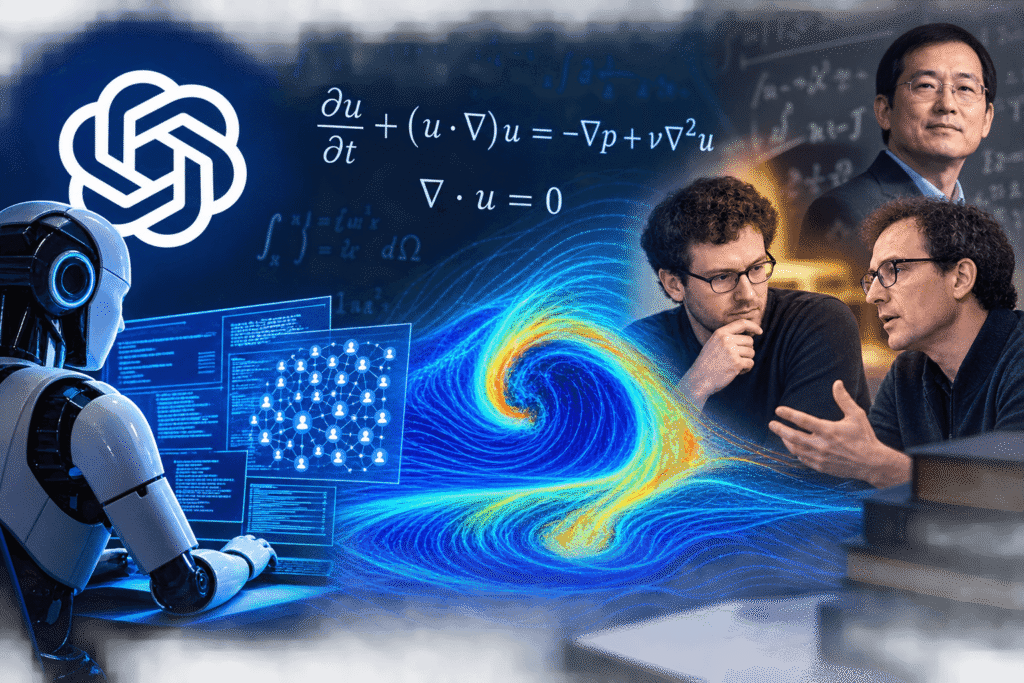
The Navier-Stokes equations are a set of mathematical equations, based on Newton’s second law, that describe how fluids like water and air move, treating fluid as a continuous substance rather than tracking individual molecules. They’re used to model everything from weather systems and ocean currents to airflow around aircraft. The Millennium Prize version of the problem, one of seven identified by the Clay Mathematics Institute in 2000, does not ask for a way to solve the equations for specific cases — that has been done numerically for decades — but instead asks for a rigorous mathematical proof of certain theoretical properties of the equations’ solutions, a task mathematicians have worked on for over two centuries without full resolution.
What Happens Next?
The mathematics community, including prominent figures like Fields Medalist Terence Tao, is expected to continue scrutinizing both the OpenAI-affiliated result and the competing Alpöge-Buckmaster effort in the coming weeks, given the significance and complexity of formally verifying a claimed resolution to a Millennium Prize Problem. Given the technical depth involved, independent confirmation from the wider mathematical community will likely take time.
FAQs
Q: Did OpenAI actually solve the Navier-Stokes equations?
OpenAI says its AI system resolved part of the Navier-Stokes existence and smoothness Millennium Prize Problem — a proof about theoretical properties of the equations’ solutions — not a general closed-form or numerical “solution” to the equations themselves.
Q: Is OpenAI claiming the $1 million prize?
No, OpenAI has said it does not intend to claim the Clay Mathematics Institute’s Millennium Prize for this result.
Q: Why are mathematicians skeptical of this claim?
The claim involves a complex, unverified result produced largely by AI agents, alongside a separate, competing claim from other researchers, raising questions about verification, credit, and methodology that the mathematics community is still working through.
Q: What is the Navier-Stokes Millennium Prize Problem?
One of seven Millennium Prize Problems identified by the Clay Mathematics Institute in 2000, asking for a rigorous proof of certain theoretical properties of solutions to the Navier-Stokes equations, which describe fluid motion.
Q: Who else claims to have worked on a similar solution?
NYU mathematician Tristan Buckmaster and Anthropic researcher Levent Alpöge are cited as having a separate, independent effort, which OpenAI is recognizing in a joint announcement.