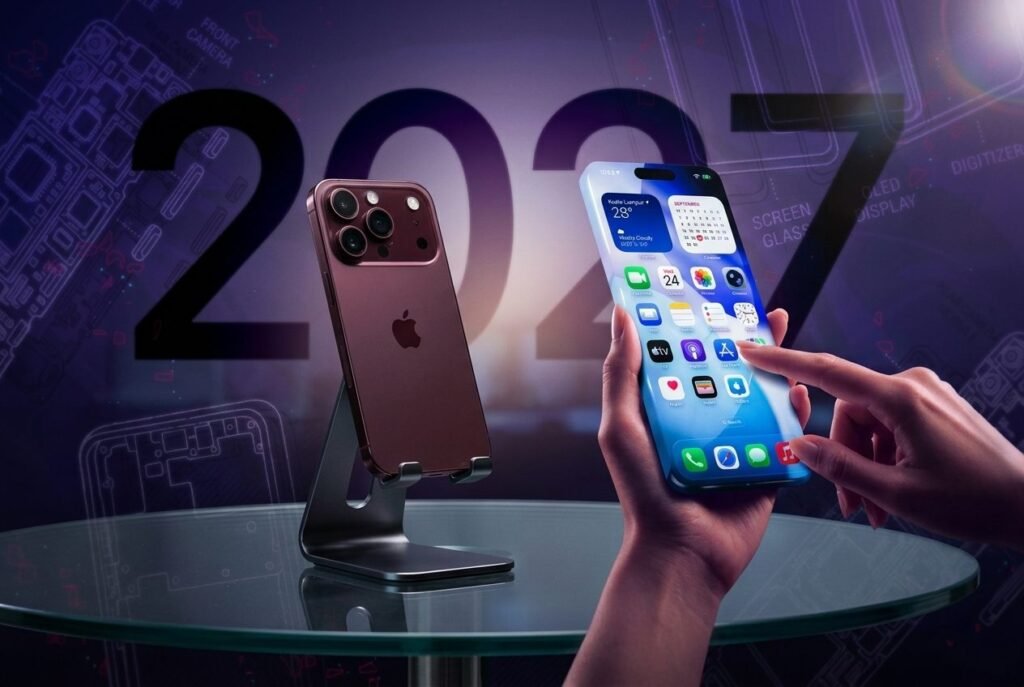
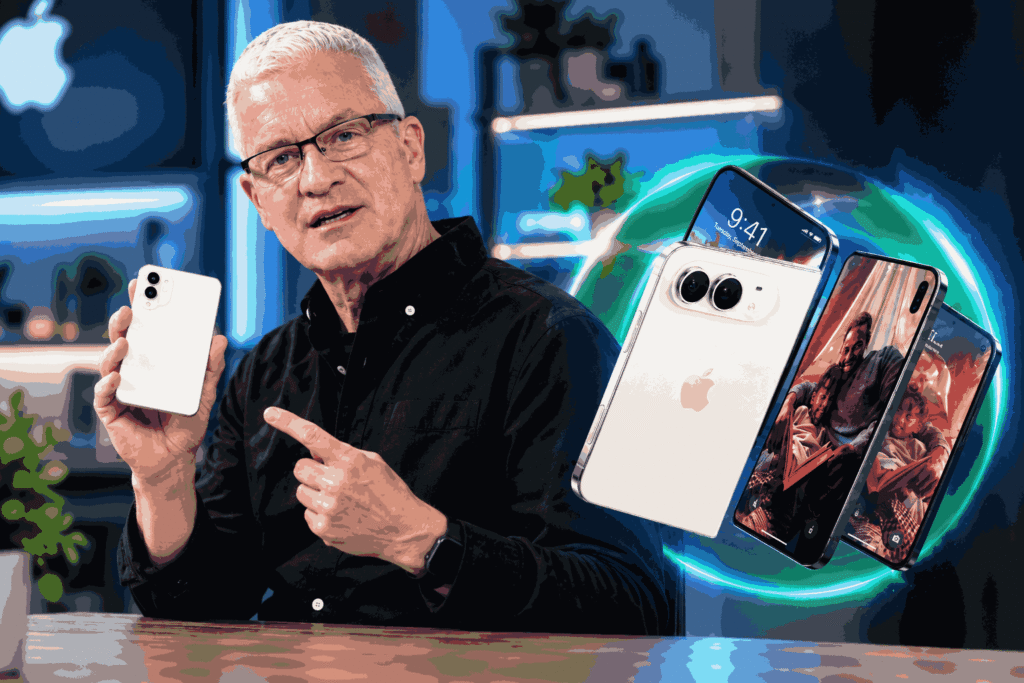
Apple has finally done what rumor sites spent two years arguing about: it built a folding iPhone. The iPhone Duo is Apple’s first foldable smartphone, unveiled on September 9, 2026, and it changes the shape of the iPhone for the first time since 2007. If you have been searching for the iPhone Duo price, the iPhone Duo release date, or how this Apple foldable iPhone Duo actually compares to the Samsung Galaxy Z Fold 8, this guide covers everything Apple has confirmed so far, in one place.
In short: the iPhone Duo starts at $1,999, opens into a 7.6-inch inner display, closes down to a 5.4-inch outer screen, runs on the same A20 Pro chip found in the iPhone 18 Pro line, and goes on sale October 23, 2026, with preorders opening October 16. Below, we break down the design, display, performance, camera, battery, software, pricing, and how the Duo stacks up against its closest rivals.
What Is the iPhone Duo?
The iPhone Duo is Apple’s first book-style foldable iPhone. It opens like a small notebook, revealing a large inner screen, and closes flat into a compact, pocket-sized rectangle roughly the size of a passport. Apple’s new CEO, John Ternus, introduced the device at the company’s “Surprise and Shine” keynote, calling it the most transformational change to the iPhone since the original model. It was his first keynote appearance since taking over as CEO on September 1, 2026.
For years, leakers and tech blogs debated what Apple would eventually call this device. Some insisted on “iPhone Fold,” others pushed “iPhone Ultra,” and Bloomberg reporting suggested Apple’s own staff referred to it internally by yet another name. As of September 9, 2026, that debate is settled: the official name is iPhone Duo, and it sits alongside the iPhone 18 Pro and iPhone 18 Pro Max as part of Apple’s fall 2026 lineup.
The core idea behind the iPhone Duo is simple. Most of the time, you use it closed, like a normal iPhone, on its 5.4-inch outer display. When you want more room, for a video, a document, a game, or two apps running side by side, you unfold it into a 7.6-inch inner display that Apple says is its largest iPhone screen ever.
iPhone Duo Release Date and Availability
Apple confirmed a clear rollout schedule for the iPhone Duo:
- Preorders open Friday, October 16, 2026, at 5:00 a.m. Pacific Time
- The iPhone Duo release date for general availability is Friday, October 23, 2026
- It launches in more than 70 countries and regions on that first day
- An additional 28 countries and regions get the device on October 30, 2026
- It ships running iOS 27.1 out of the box
Production has reportedly not been simple. Multiple supply-chain reports indicated that the foldable iPhone faced early manufacturing hurdles, and as late as August 2026 only a few hundred units per day were reportedly coming off the line before mass production ramped up ahead of launch. Apple is said to have placed orders for around 10 million foldable iPhone units for the initial production run, which suggests the company expects strong demand for the iPhone Duo despite the high starting price.
iPhone Duo Price and Storage Options
The iPhone Duo price starts at $1,999 for the base 256GB model. Apple is offering four storage tiers this year:
- 256GB — $1,999
- 512GB — pricing confirmed at launch, positioned between the 256GB and 1TB tiers
- 1TB — mid-to-upper storage tier for power users
- 2TB — the top tier, priced at $3,199
That $1,999 starting price puts the iPhone Duo well above every standard iPhone 18 model and roughly in the same range as Samsung’s Galaxy Z Fold 8 and Google’s latest foldable. Apple is clearly not trying to undercut the foldable market on price. Instead, it is betting that the iPhone Duo’s software integration, camera system, and build quality will justify the premium for buyers who already live inside the Apple ecosystem.
Apple also introduced official accessories alongside the phone: the iPhone Duo Case at $79 and a Folio case with a built-in kickstand at $129, aimed at people who want to prop the inner screen up on a table without buying a separate stand.
Design and Durability: Titanium, Hinge, and Colors
Apple built the iPhone Duo around a Grade 5 titanium frame, the same family of material used in recent iPhone Pro models, chosen for its strength-to-weight ratio. The company says the hinge mechanism uses more than 100 precision parts engineered to deliver a smooth, resistant feel whether you are opening it slowly or snapping it shut.
Foldable phones have historically struggled with three complaints: a visible crease down the middle of the inner screen, hinges that wear out or feel loose over time, and durability concerns around a screen that physically bends every day. Apple’s pitch on the iPhone Duo tries to answer all three:
- A nano-texture finish on the inner display is designed to scatter light and make the crease far less visible in normal use
- The titanium hinge is rated for sustained daily folding, with Apple pointing to internal durability testing in the hundreds of thousands of cycles
- The device carries an IP68 rating for dust and water resistance, matching Apple’s flagship non-folding iPhones, which is notable since folding phones typically struggle to seal against dust ingress around the hinge
Closed, the iPhone Duo measures 117.8 x 84.1 x 11.3mm and weighs about 254 grams. Opened, it is 117.8 x 164.6 x 5.2mm, which Apple markets as the thinnest iPhone ever produced when unfolded. For comparison, that unfolded thickness is thinner than a standard iPhone 18 Pro. On weight, though, the Duo is noticeably heavier than Samsung’s Galaxy Z Fold 8, which comes in at around 201 grams, and it is about 5 grams heavier than the iPhone 18 Pro Max.
The iPhone Duo is available in two colors: Star White and Night Sky, a white finish and a dark blue-black finish, both with polished titanium rails around the edge.
iPhone Duo Displays: Inner and Outer Screens
Display quality is the single biggest selling point of any foldable phone, and Apple leaned hard into this with the Duo. The device uses two separate OLED panels:
- Outer display: 5.4 inches, used for everyday tasks when the phone is closed, offering about 90 percent of the screen area of the iPhone 18 Pro’s display
- Inner display: 7.6 inches, revealed when you unfold the phone, which Apple says is roughly 50 percent larger than the iPhone 18 Pro Max’s screen
Both panels share the same aspect ratio, so content resizes proportionally rather than being cropped or stretched when you move from the outer screen to the inner screen. Both displays run at a 120Hz refresh rate for smooth scrolling and animations, and the inner display carries that nano-texture, anti-glare coating designed to reduce reflections during outdoor use and minimize the visual impact of the fold line.
One notable design decision: Apple gave the iPhone Duo a hidden under-display selfie camera on the inner screen, letting the panel run nearly edge-to-edge without a visible notch or punch-hole cutout interrupting the display when unfolded.
Performance: A20 Pro Chip
Rather than building a brand-new chip specifically for the folding form factor, Apple used its existing flagship silicon. The iPhone Duo runs on the same A20 Pro chip found in the iPhone 18 Pro and iPhone 18 Pro Max, built on a 2-nanometer manufacturing process. Key specifications include:
- 6-core CPU with two performance cores and four efficiency cores, which Apple says runs up to 20 percent faster than the previous A19 Pro
- 7-core GPU with Neural Accelerators, up to 40 percent faster than the prior generation while using less power
- A new Dual 16-core Neural Engine, doubling on-device AI compute compared to the last generation, which matters directly for Apple Intelligence features
- A custom vapor chamber cooling system, which Apple claims delivers up to 35 percent better sustained performance than the iPhone 17 Pro during demanding tasks like gaming or video editing
Apple has not officially confirmed the amount of RAM inside the iPhone Duo, which is standard practice for the company. Pre-launch supply chain reports pointed to at least 12GB, partly because that is understood to be the minimum needed to run Apple’s on-device Siri and Apple Intelligence features smoothly, but this figure remains unconfirmed until independent teardowns verify it.
In real-world terms, this means the iPhone Duo should perform almost identically to the iPhone 18 Pro Max in raw CPU and GPU tasks, with the main performance differentiator coming down to thermal management given the phone’s unique folding chassis.
iPhone Duo Camera System
The iPhone Duo carries a 48MP Dual Fusion rear camera system rather than the triple-camera setup found on the iPhone 18 Pro. There is no dedicated telephoto lens, though Apple says the system supports up to 4x optical-quality zoom through sensor cropping and computational processing. The two rear lenses are:
- Main camera: 48MP, 26mm equivalent, f/1.6 aperture
- Ultra-wide camera: 48MP, 13mm equivalent, f/2.2 aperture, 120-degree field of view
Because the iPhone Duo has both an inner and outer display, and can stand partially folded on its own like a tiny tent, Apple built several camera features that don’t exist on any other iPhone:
- Smart Take — uses the A20 Pro’s Neural Engine to automatically capture a photo the moment everyone in frame is posed and looking at the camera
- Duo Preview — shows a live preview on the outer display so the people you are photographing with the rear camera can see themselves and adjust before the shot
- Kid Cue — plays short animations on the outer screen to help get young children to look toward the camera
- Duo FaceTime — lets a second person standing nearby join an ongoing FaceTime call using the outer display and its camera, without needing their own device
On video, the iPhone Duo records 4K at up to 120fps in Dolby Vision on the main camera, applies Cinematic mode effects after recording, and supports 4K time-lapse capture in Dolby Vision HDR, with the ability to prop the phone up hands-free using the partial-fold stance.
Battery Life and Charging
The iPhone Duo uses a dual-battery architecture, with one battery cell built into each half of the folding chassis, working together as a single combined power source managed by iOS. Apple’s official battery life estimates are:
- Up to 31 hours of video playback when primarily using the inner display
- Up to 44 hours of video playback when primarily using the outer display
- Up to 24 hours of typical mixed use across both displays
On charging, the iPhone Duo supports fast wired charging that reaches roughly 50 percent battery in about 20 minutes with a 60W USB-C adapter, and wireless charging that hits 50 percent in around 30 minutes using a MagSafe or Qi2-compatible charger. The device is eSIM-only worldwide, meaning there is no physical SIM tray on any model, and it uses Apple’s newer C2 modem, which the company says is up to 50 percent faster than the previous C1X modem while consuming up to 15 percent less power, a meaningful factor for all-day battery life on a device running two large displays.
Software: iOS 27, Apple Intelligence, and Multitasking
Apple rebuilt large portions of iOS specifically around the folding form factor rather than simply stretching the existing iPhone interface across a bigger screen. On the iPhone Duo, iOS 27 enables:
- Running two apps side by side on the inner display at the same time
- Launching two separate instances of the same app simultaneously, useful for messaging or email accounts
- Saving specific app pairings so your preferred split-screen layout reopens automatically
- A tabletop mode that activates automatically when the phone is partially folded and stood up, adjusting the interface so the top half acts as a display and the bottom half becomes a control surface
- Automatic interface adaptation as the device is opened, closed, or rotated, without requiring the user to manually resize anything
Apple confirmed that third-party developers, including Zoom and Slack, are already redesigning their apps to take advantage of the dual-screen, split-view layout. Authentication on the iPhone Duo relies on Touch ID built into the side button rather than Face ID, a notable departure from every other current iPhone, likely driven by the engineering challenge of fitting a Face ID sensor array behind a folding, crease-prone inner display.
Apple Intelligence is fully supported on the iPhone Duo, and the phone’s larger inner display and stronger Neural Engine make it one of the more capable devices in Apple’s lineup for on-device AI tasks like writing tools, image generation, and Siri’s expanded contextual features. Apple Pencil (USB-C) support is confirmed for both displays, though Apple says that capability will arrive later in 2026 through a software update rather than at launch.
iPhone Duo vs Samsung Galaxy Z Fold 8
Apple enters the foldable market roughly seven years after Samsung, which has led the book-style foldable category since 2019 and shipped around 19.6 million foldable units globally in 2025, still a small fraction of total smartphone sales. Here is how the two flagships compare on the numbers Apple and Samsung have each confirmed:
- Weight: The Galaxy Z Fold 8 is lighter at roughly 201g, compared to 254g for the iPhone Duo
- Starting price: Both devices launch in a similar $1,900–$2,000 price bracket for base storage
- Biometrics: Samsung’s Fold line uses an in-display or side fingerprint sensor alongside face recognition; the iPhone Duo relies solely on Touch ID
- Ecosystem: The iPhone Duo’s main differentiator is software polish and tighter integration with iOS, Apple Intelligence, and the wider Apple device ecosystem, an area where Samsung’s Android-based One UI has had years longer to mature specifically for foldables
Apple’s marketing chief has been openly critical of the current state of rival foldables, suggesting Apple waited to enter the category until it felt the hardware and software could be engineered together properly rather than rushing a first-generation product. Whether that patience shows up as a meaningfully better everyday experience is something reviewers are only beginning to test.
iPhone Duo vs iPhone 18 Pro
Since the iPhone Duo shares its A20 Pro chip with the standard iPhone 18 Pro and iPhone 18 Pro Max, raw performance is closely matched across all three phones. The real differences show up elsewhere:
- The iPhone Duo trades the iPhone 18 Pro’s triple-camera telephoto system for a simpler dual 48MP setup, prioritizing the folding mechanism over zoom range
- The iPhone Duo uses Touch ID instead of Face ID
- The iPhone Duo’s inner display is about 50 percent larger than the iPhone 18 Pro Max screen, but the phone is thicker and heavier when closed
- All three phones offer storage from 256GB up to 2TB
- The iPhone Duo starts several hundred dollars above the iPhone 18 Pro Max
For most buyers, the decision comes down to whether the larger inner screen and multitasking features are worth the added bulk, cost, and camera trade-offs, or whether a conventional flagship iPhone still covers their needs better.
How Wall Street Reacted: Apple Stock After the iPhone Duo Launch
Despite the scale of the announcement, the market reaction was muted. Apple stock actually slipped about 1.9 percent in afternoon trading on launch day, a sign that investors had already priced in most of the news given how heavily the foldable iPhone had been rumored throughout 2025 and 2026. Analysts have pointed out that foldables still represent a small slice of the overall smartphone market, so the iPhone Duo’s near-term impact on Apple’s revenue is likely to be modest compared to the standard iPhone 18 lineup, even if it succeeds in pulling in new customers who have been waiting specifically for an Apple foldable.
The bigger question for Apple’s stock going forward is whether the iPhone Duo can do for foldables what AirPods did for wireless earbuds and the Apple Watch did for smartwatches: take a niche category and turn it mainstream through better execution and ecosystem lock-in, rather than being first to market.
iPhone Duo vs Global Foldable Rivals: Huawei and Xiaomi
Apple is not only competing with Samsung. Just days before Apple’s own event, Chinese manufacturers Huawei and Xiaomi both launched their newest foldable phones, priced at $2,980 and $3,725 respectively in their home markets, positioning them well above the iPhone Duo’s $1,999 starting price. Both companies have spent years refining ultra-thin folding hinges and have pushed hard on reducing the visible crease, one of the exact problems Apple says its nano-texture display and titanium hinge are designed to solve.
The fact that Huawei and Xiaomi priced their latest foldables even higher than the iPhone Duo suggests the entire premium foldable category is settling into the $2,000-plus range globally, rather than foldables becoming a budget-friendly alternative to flat phones anytime soon. For now, foldable phones across every brand, Apple included, remain a premium, early-adopter purchase rather than a mainstream default.
Foldable phone makers across the industry have also worked hard to reassure buyers about long-term reliability. Some brands have published stress-test videos claiming their hinges survive 200,000 or more open-close cycles in lab conditions. Apple has made similar durability claims about the iPhone Duo’s hinge, though independent long-term testing from reviewers will ultimately determine how these numbers translate into real-world use over two or three years of daily folding.
Early Hands-On Impressions of the iPhone Duo
Journalists who got brief hands-on time with the iPhone Duo immediately after the September 9 announcement described a device that feels distinctly Apple in its execution, even if the underlying idea of a book-style foldable is not new. Reviewers noted that Apple appears to be thinking about the iPhone Duo less as “a bigger iPhone” and more as a device that can change how people use their phone in specific moments, for example, propping it up like a small bedside clock or presentation screen using the partial-fold stance.
At the same time, early impressions were not universally glowing. Several reviewers pointed out that at nearly $2,000, the iPhone Duo is a significant financial commitment for a first-generation Apple product in a category that, industry-wide, still accounts for only a small sliver of total smartphone sales. The consistent theme across early coverage is that the software experience, split-screen multitasking, app pairing, and the outer-display camera tricks, feels more thought-through than most rival foldables, even if the hardware specs alone don’t dramatically leapfrog Samsung’s latest Galaxy Z Fold.
Apple’s own framing has been ambitious. Company leadership has described the iPhone Duo as redefining what people should expect from a folding phone, arguing that pairing custom silicon, a purpose-built version of iOS, and Apple’s own display engineering produces a more cohesive result than assembling similar hardware around an off-the-shelf version of Android. Independent, longer-term reviews over the coming weeks will be the real test of that claim, particularly around hinge durability, crease visibility after months of use, and battery health over repeated charge cycles.
iPhone Duo Accessories and How to Preorder
Alongside the phone itself, Apple confirmed two first-party accessories built specifically for the Duo’s folding shape:
- iPhone Duo Case — $79, a slim protective case designed to work with the fold mechanism without adding excessive bulk
- iPhone Duo Folio — $129, a case with a built-in kickstand, aimed at people who plan to use the tabletop mode for video calls, media, or propped-up typing
If you plan to preorder the iPhone Duo, here is the timeline to keep in mind:
- Preorders open Friday, October 16, 2026 at 5:00 a.m. Pacific Time through Apple’s website and the Apple Store app
- In-store and online general availability begins Friday, October 23, 2026 in the first wave of over 70 countries and regions
- A second wave of 28 additional countries and regions gets access starting October 30, 2026
- The device is eSIM-only everywhere it launches, so check with your carrier ahead of time if you rely on a physical SIM card or are switching networks
Given the reports of slow early production ramp-up, anyone specifically set on Star White or Night Sky in a particular storage tier may want to preorder as close to the October 16 window as possible, since constrained early supply is common for first-generation Apple hardware, and even more likely for a device this mechanically complex.
iPhone Duo Specs at a Glance
- Name: iPhone Duo (Apple’s first foldable iPhone)
- Announced: September 9, 2026
- Release date: October 23, 2026 (preorders October 16, 2026)
- Price: From $1,999 (256GB) up to $3,199 (2TB)
- Storage options: 256GB, 512GB, 1TB, 2TB
- Chip: Apple A20 Pro, 2nm process, 6-core CPU, 7-core GPU, Dual 16-core Neural Engine
- Outer display: 5.4 inches, 120Hz
- Inner display: 7.6 inches, 120Hz, nano-texture anti-glare finish
- Rear cameras: 48MP Main (f/1.6) + 48MP Ultra Wide (f/2.2), up to 4x optical-quality zoom, no telephoto lens
- Biometrics: Touch ID in the side button (no Face ID)
- Battery: Dual-cell architecture, up to 44 hours video playback (outer display), up to 24 hours typical mixed use
- Charging: Up to 50% in ~20 minutes wired (60W), ~30 minutes wireless (MagSafe/Qi2)
- Connectivity: eSIM-only worldwide, Apple C2 modem
- Build: Grade 5 titanium frame, IP68 dust and water resistance
- Colors: Star White, Night Sky
- Closed dimensions: 117.8 x 84.1 x 11.3mm, ~254g
- Unfolded dimensions: 117.8 x 164.6 x 5.2mm (Apple’s thinnest iPhone ever unfolded)
- Software: iOS 27.1 out of the box, full Apple Intelligence support, Apple Pencil (USB-C) support coming later in 2026
Should You Buy the iPhone Duo?
The iPhone Duo makes the most sense for a specific type of buyer. Consider it if:
- You regularly multitask between two apps and want a genuinely larger screen without carrying a separate tablet
- You are already invested in Apple’s ecosystem and want the newest form factor as soon as it ships
- You value having the largest possible iPhone display for video, reading, or gaming, and are comfortable trading some pocketability for it
- Budget is a secondary concern compared to owning Apple’s newest, most capable device
It probably is not the right upgrade if you want the best possible camera system Apple sells, since the iPhone Duo skips the telephoto lens found on the iPhone 18 Pro. It is also not ideal if minimal weight and slim pocket presence matter more to you than screen size, since the Duo is heavier than both the standard iPhone 18 Pro Max and Samsung’s closest competing foldable.
iPhone Duo FAQs
What is the iPhone Duo price?
The iPhone Duo starts at $1,999 for the 256GB model, with 512GB and 1TB options in between, and a 2TB top tier priced at $3,199.
When is the iPhone Duo release date?
Preorders open October 16, 2026. The iPhone Duo becomes available in more than 70 countries and regions on October 23, 2026, followed by 28 additional countries and regions on October 30, 2026.
What chip does the iPhone Duo use?
The iPhone Duo runs on Apple’s A20 Pro chip, the same chip used in the iPhone 18 Pro and iPhone 18 Pro Max, built on a 2-nanometer process with a 6-core CPU, 7-core GPU, and Dual 16-core Neural Engine.
Does the iPhone Duo have Face ID?
No. The iPhone Duo uses Touch ID built into the side button instead of Face ID.
What screen sizes does the iPhone Duo have?
It has a 5.4-inch outer display for everyday use when closed, and a 7.6-inch inner display when unfolded, both running at 120Hz with matching aspect ratios.
Is the iPhone Duo waterproof?
It carries an IP68 rating for dust and water resistance, matching Apple’s non-folding flagship iPhones.
Was the iPhone Duo previously called iPhone Fold or iPhone Ultra?
Yes. Before the official September 9, 2026 announcement, rumors and leaks referred to Apple’s foldable iPhone under both the iPhone Fold and iPhone Ultra names. Apple settled on iPhone Duo as the final, official product name.
Sources and Further Reading
- Apple Newsroom — Apple unveils iPhone Duo (official announcement)
- Wikipedia — iPhone Duo
- CNN Business — What it’s like to use the iPhone Duo
- NBC News — Apple announces foldable iPhone Duo, iPhone 18 Pro and Pro Max
Final Verdict on the iPhone Duo
The iPhone Duo is not a rushed reaction to Samsung. It arrives years after the first Galaxy Fold, with a titanium build, a genuinely reworked version of iOS, dual-battery engineering, and camera features built specifically around having two screens instead of one. At $1,999 and up, it is priced as a statement device rather than a mass-market upgrade, but it gives Apple a real answer to the one major smartphone category it had never entered. Whether the iPhone Duo becomes as central to Apple’s lineup as the standard iPhone will depend on how the folding hinge and displays hold up over years of daily use, something only time, and real-world reviews, will be able to confirm.