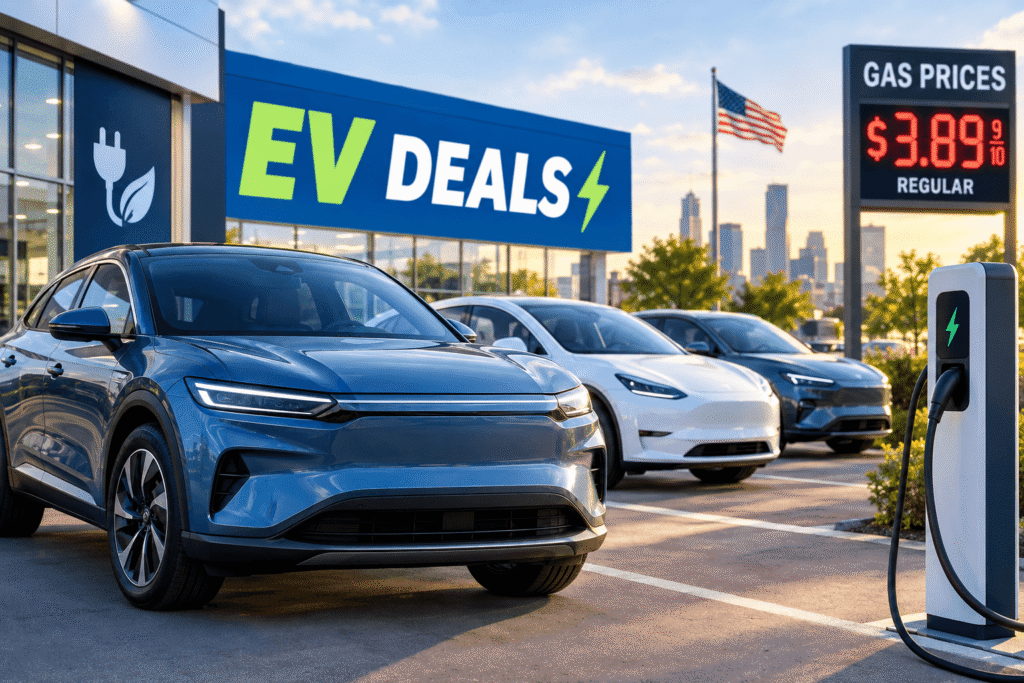
Electric vehicle deals are flooding the U.S. market this September as automakers push aggressive financing offers to overcome stubbornly high gas prices, even as broader industry data shows battery-electric vehicle adoption stagnating relative to earlier growth projections.
Quick Answer / Key Update
Automakers are offering some of the strongest EV deals of the year in September 2026, including 0% interest financing on select models, as gas prices remain high across the U.S. However, industry-wide data shows battery-electric vehicle (BEV) adoption in the U.S. is stagnating, with EVs still carrying a 15 to 20 percent price premium over the overall market average transaction price.
What Happened?
With gas prices remaining stubbornly elevated, automakers are using September’s model-year transition period to offer lease, financing, and cash-back incentives designed to pull hesitant buyers into the EV market. Offers span the full price range, from budget-friendly models to six-figure luxury EVs, with some manufacturer-backed financing rates well below the average 6.94% rate currently charged by banks and credit unions for a typical 60-month auto loan.
At the same time, broader industry reporting shows Volkswagen Group has approved a "Future Plan 2030" targeting a workforce reduction of around 50,000 employees, alongside a 50% smaller model portfolio by 2035, reflecting deeper structural pressure across the global auto industry.
Latest Update
Newly redesigned EVs are seeing strong buyer interest this month, including the 2026 Hyundai Ioniq 9, recently recognized as a top electric SUV for road-tripping and camping use cases, and the redesigned Toyota bZ, which industry reviewers say has significantly improved over its 2023 predecessor with a longer range, more power, and updated styling. Meanwhile, China’s EV export dynamics continue to shift, with Western brands seeing sharply reduced battery-electric vehicle imports into China, down to just 125 units in July 2026 compared to tens of thousands annually in prior years.
Why Is This Trending?
Interest in EV deals and automotive industry news is rising because September is a key seasonal window for car shopping as automakers clear out current model-year inventory, combined with ongoing high gas prices pushing more budget-conscious buyers to seriously consider electric alternatives for the first time.
Key Details
- EV price premium vs. overall market: 15% to 20% higher average transaction price
- Average auto loan rate: 6.94% for a 60-month loan (banks and credit unions)
- Notable EV deals: Some manufacturer financing offers at 0% interest
- Volkswagen Future Plan 2030: Approximately 50,000 workforce reduction, 50% smaller model portfolio by 2035
- China BEV imports from Western brands: Just 125 units in July 2026
- Notable models: 2026 Hyundai Ioniq 9, redesigned Toyota bZ
What We Know So Far
Confirmed: Current EV financing and lease deals for September 2026 are confirmed through manufacturer and dealer offers. Volkswagen’s Future Plan 2030 workforce and portfolio reduction targets have been reported as approved by the company.
Developing: Information is not yet confirmed on exactly how long current EV financing incentives will remain available, as manufacturer offers typically change monthly based on inventory and sales targets.
Why This Matters
The combination of stagnating BEV adoption and aggressive financing incentives highlights a pivotal moment for the auto industry: automakers have made major investments in EV production, but consumer demand has not grown as quickly as earlier industry forecasts predicted, at least in the U.S. market. Structural moves like Volkswagen’s planned workforce reduction reflect how automakers are recalibrating long-term strategy in response to slower-than-expected EV uptake, elevated input costs, and margin pressure across the industry.
For consumers, this creates a window of opportunity: strong incentives mean buyers willing to consider an EV this September may find better financing terms than they would during periods of stronger EV demand.
What Happens Next?
Industry analysts expect battery pack costs to continue declining, potentially making EVs more price-competitive with gasoline vehicles by 2028 to 2029, which could accelerate adoption if paired with continued investment in charging infrastructure. In the near term, expect automakers to continue adjusting incentives monthly based on inventory levels and sales performance heading into the final quarter of 2026.
Related Trends and Searches
Related searches include "best EV deals this month," "EV financing rates 2026," "Volkswagen job cuts 2030," and "electric vehicle price comparison," reflecting strong consumer interest in whether now is a good time to buy an EV.
Frequently Asked Questions
Are EV deals good this September?
Yes, several automakers are offering strong incentives, including 0% interest financing on select models, as they work to boost EV demand.
Why is battery-electric vehicle adoption stagnating in the U.S.?
EVs currently carry a 15 to 20 percent price premium over the overall market average transaction price, which continues to limit broader adoption despite incentives.
What is Volkswagen’s Future Plan 2030?
It is a strategic plan targeting a workforce reduction of around 50,000 employees and a 50% smaller model portfolio by 2035, reflecting broader industry cost pressures.
Which EVs are getting attention this month?
The 2026 Hyundai Ioniq 9 and the redesigned Toyota bZ have both drawn positive reviews for range, power, and overall improvements.
Why are Western automakers exporting fewer EVs to China?
Reports indicate Western brand battery-electric vehicle imports into China dropped sharply, to just 125 units in July 2026, reflecting shifting trade and competitive dynamics.
When will EVs become as affordable as gas cars?
Analysts expect declining battery pack costs to make EVs more price-competitive with gasoline vehicles by around 2028 to 2029.
What auto loan rate should I expect for an EV?
Bank and credit union rates for a typical 60-month auto loan currently average around 6.94%, though manufacturer-backed offers can be significantly lower for qualified buyers.