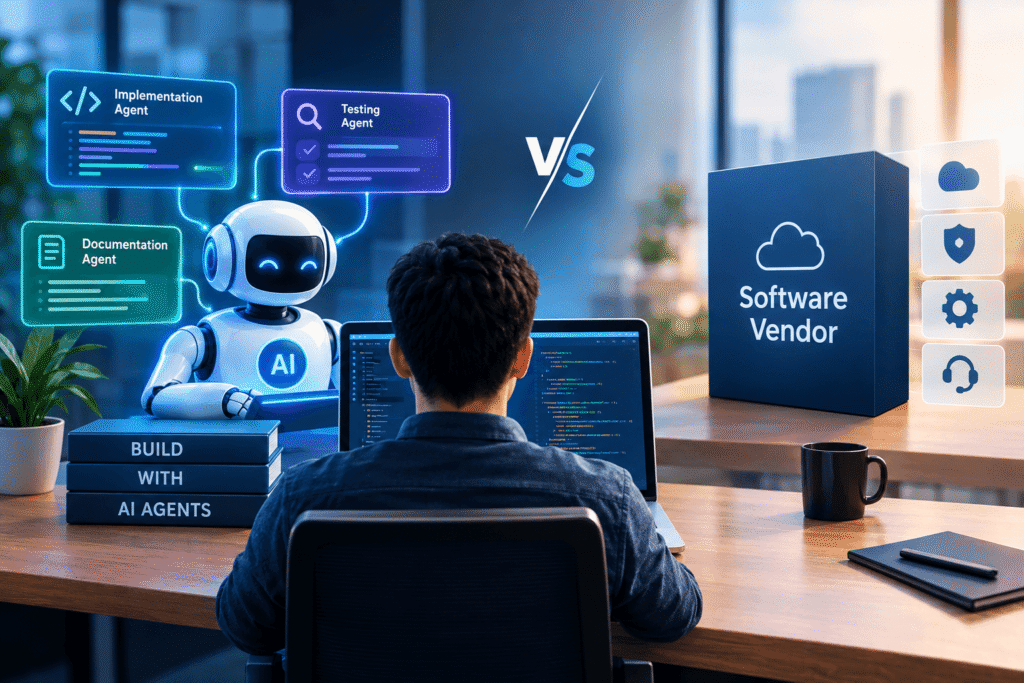
A growing number of companies are choosing to build software internally using AI-powered coding agents rather than buy it from vendors, according to new research, signaling a structural shift in how businesses approach technology spending in 2026.
Quick Answer / Key Update
A McKinsey research report found that nearly one-third of surveyed organizations had decided against purchasing at least one software product or feature because they could build the functionality internally using AI-powered coding agents. Meanwhile, GitHub Copilot Workspace now supports multiple specialized AI agents working simultaneously on different parts of a codebase, and the open-source autonomous coding agent OpenHands has reached its 1.0 release with production-ready security features.
What Happened?
As agentic coding tools have matured through 2026, engineering teams have gained the ability to delegate distinct software development roles, implementation, testing, and documentation, to separate AI agents that coordinate within a shared project context. GitHub’s latest Copilot Workspace update reflects this shift, allowing multiple agents to work in parallel on a single codebase rather than relying on a single assistant handling all tasks sequentially.
Separately, OpenHands, a widely used open-source autonomous coding agent, reached its 1.0 release with production-ready Docker sandboxing, built-in security policies, resource limits, and a plugin system. Benchmarks show it can autonomously complete about 68% of SWE-bench Verified tasks, a standard measure of real-world software engineering task completion.
Latest Update
The McKinsey report’s finding, that roughly one in three organizations chose to build rather than buy software due to AI-powered coding agents, is described as a growing factor tilting corporate technology budgets toward internal development over vendor licenses. This trend puts pressure on software vendors, particularly those selling niche tools whose functionality can now be more easily replicated in-house using agent-driven development scripts.
Why Is This Trending?
Interest in this story is rising because it represents a meaningful shift in enterprise software economics: for decades, building custom software internally was often more expensive and slower than buying an established vendor product. AI coding agents are beginning to invert that calculation for certain use cases, which has significant implications for both software buyers and the vendors who sell to them.
Key Details
- McKinsey finding: Nearly one-third of organizations skipped a software purchase in favor of internal AI-agent development
- GitHub Copilot Workspace update: Multiple specialized agents (implementation, testing, documentation) working in parallel
- OpenHands 1.0: Production-ready Docker sandboxing, security policies, resource limits, plugin system
- OpenHands benchmark: Completes approximately 68% of SWE-bench Verified tasks autonomously
- Key implication: Software vendors face pressure to justify licenses with capabilities hard to replicate via agent scripts
What We Know So Far
Confirmed: The McKinsey survey findings and the GitHub Copilot Workspace multi-agent feature update are confirmed through official reporting. OpenHands’ 1.0 release and its benchmark performance are documented by the project.
Developing: Information is not yet confirmed on exactly how software vendors will respond commercially to this shift, though industry discussion suggests increased emphasis on proprietary data, specialized workflows, and compliance guarantees as differentiators.
Why This Matters
This shift matters because it reshapes competitive dynamics across the entire software industry, not just for developer tools. As agentic coding tools become more capable, software vendors selling replicable, narrowly scoped functionality face growing pressure, while those offering proprietary data, deep domain expertise, or strict compliance and support guarantees may be better positioned to retain customers. For CIOs and engineering leaders, this trend introduces a new procurement question: whether a needed capability should be bought or built using an internal agent-led development project.
What Happens Next?
Expect procurement processes at more organizations to formally incorporate a "can agents build this safely?" evaluation step, weighing agent development cost and risk against vendor licensing costs. As tools like OpenHands and GitHub Copilot Workspace continue maturing, benchmark performance on tasks like SWE-bench Verified will likely become an increasingly important metric for engineering leaders evaluating which agentic tools to adopt.
Related Trends and Searches
Related searches include "AI coding agents 2026," "build vs buy software AI," "GitHub Copilot Workspace multi-agent," and "OpenHands autonomous coding agent," reflecting growing interest in how AI is changing enterprise software development and purchasing decisions.
Frequently Asked Questions
What did the McKinsey report find about AI coding agents?
It found that nearly one-third of surveyed organizations decided against purchasing at least one software product or feature because they could build the functionality internally using AI-powered coding agents.
What is GitHub Copilot Workspace’s new multi-agent feature?
It allows multiple specialized AI agents, for implementation, testing, and documentation, to work simultaneously on different parts of a codebase while coordinating through a shared context.
What is OpenHands?
OpenHands is an open-source autonomous coding agent that reached its 1.0 release with production-ready security features and can autonomously complete about 68% of SWE-bench Verified tasks.
Does this mean companies will stop buying software?
No, but it does mean some organizations are reconsidering whether certain software needs can be met through internal AI-agent development instead of vendor purchases, particularly for replicable functionality.
How should software vendors respond to this trend?
Industry discussion suggests vendors should emphasize differentiators that are hard to replicate with agent scripts, such as proprietary data, specialized workflows, and guaranteed compliance and support.
What is SWE-bench Verified?
It is a benchmark used to measure how well AI coding agents can autonomously complete real-world software engineering tasks.
Is AI-agent-built software as reliable as vendor software?
Reliability varies by use case and depends on the maturity of the agent tooling and the guardrails organizations put in place; complex or compliance-sensitive functionality still often favors established vendor solutions.