The latest iPhone rumors have taken a sharp turn in the last two weeks. Apple has already launched the iPhone 18 Pro, iPhone 18 Pro Max and its first-ever foldable — and yet the rumor mill has barely paused for breath. Attention has jumped straight to 2027, to a device that may not even be called the iPhone 19. If you have been trying to separate credible reporting from recycled speculation, this guide pulls every thread together in one place.
What Are the Latest iPhone Rumors Right Now?
As of September 2026, the most credible latest iPhone rumors point to five things: Apple skipping the “iPhone 19” name and jumping to iPhone 20 for the 2027 twentieth-anniversary flagship; an all-glass, curved, cutout-free design; a second-generation 2nm A21 Pro chip; solid-state haptic buttons replacing physical ones; and a silicon-anode battery for meaningfully longer runtime. Separately, the standard iPhone 18, the iPhone 18e and the iPhone Air 2 are expected in spring 2027 rather than autumn 2026.
Latest iPhone Rumors at a Glance
| Device | Expected Timing | Status | Headline Rumor |
|---|---|---|---|
| iPhone 18 Pro / Pro Max | 18 September 2026 | Confirmed & shipping | A20 Pro, variable aperture, 2TB option |
| iPhone Duo (foldable) | 23 October 2026 | Confirmed | Apple’s first fold, from $1,999 |
| iPhone 18 / 18e | Spring 2027 | Strong rumor | Split launch cycle begins |
| iPhone Air 2 | Spring 2027 | Contested rumor | Possible second rear camera |
| iPhone 20 / anniversary model | September 2027 | Early-stage rumor | All-glass redesign, no cutouts |
| iPhone Duo 2 | Late 2027 | Speculation | Thinner hinge, telephoto added |
What Apple Actually Confirmed on 9 September 2026
Before we get into unconfirmed territory, it helps to lock down the baseline. A huge number of the latest iPhone rumors circulating online are simply restatements of things Apple has already announced, and that muddies the water badly for anyone trying to plan a purchase.
Almost every set of latest iPhone rumors you will read today builds on this foundation. Apple held its “Surprise and Shine” keynote at Apple Park on 9 September 2026. It was the first iPhone keynote fronted by new chief executive John Ternus, who had taken over from Tim Cook barely a week earlier — a detail that itself fuelled months of speculation before it happened.
iPhone 18 Pro and iPhone 18 Pro Max
Both Pro models are built around the A20 Pro, Apple’s first silicon manufactured on a 2-nanometre process. Apple quotes a GPU roughly 40% quicker than the A19 Pro and a 50% jump in memory bandwidth, paired with a redesigned vapour chamber that spreads heat across a much larger surface. In practice that matters most for sustained loads — long 4K recording sessions, heavy games, and on-device Apple Intelligence tasks that previously throttled after a few minutes.
The headline camera change is variable aperture, and crucially it is mechanical rather than computational. Six laser-cut blades physically open and close over the 48MP main sensor, the way a dedicated camera lens does. That gives genuine optical control over depth of field instead of a software approximation — a change photographers have been asking for since the iPhone 12 era.
Pricing landed at $1,199 for the iPhone 18 Pro and $1,299 for the Pro Max, each $100 above their predecessors. Given that many analysts had predicted $200 increases because of a global memory-component squeeze, the final numbers were milder than the latest iPhone rumors had suggested. Apple also introduced a 2TB storage tier on an iPhone for the first time. Colours are black, silver, glacier and burgundy.
One under-discussed change: there is no SIM tray. In the United States both Pro models are eSIM-only, and Apple reclaimed that internal space for additional battery capacity — worth roughly two extra hours of video playback by the company’s own measure. For readers in Pakistan, India and much of the Middle East, physical SIM support still exists on regional models, but it is worth checking before you import a US unit.
iPhone Duo: Apple’s First Foldable
For years the rumor community argued over whether Apple would call its foldable the iPhone Fold, the iPhone Ultra, or something else entirely. The answer was none of the above: iPhone Duo, a name referencing its two screens rather than its size or power.
It is a book-style fold with an outer OLED panel of roughly 5.4 inches and an inner display in the 7.6-to-7.8-inch range, running the same A20 Pro chip as the Pro models. The frame is grade-5 titanium with Ceramic Shield on both faces and an IP68 rating. Battery is delivered as two cells operating as one, with Apple claiming up to 31 hours of video on the inner screen and 44 hours on the outer.
The compromises are real. There is no dedicated telephoto lens — you get a 48MP main and a 48MP ultra-wide with up to 4x optical-quality zoom. It is eSIM-only in every market. And at $1,999 for 256GB, rising to around $3,199 at 2TB, it is comfortably the most expensive iPhone Apple has ever sold. Pre-orders opened 16 October with retail availability from 23 October 2026 — a five-week gap behind the Pro models that Apple has never publicly explained.
Why There Is No Standard iPhone 18 This Autumn
This is the single biggest structural change, and it is the reason so many of the latest iPhone rumors now stretch into 2027. For the first time since Apple split its line into standard and Pro tiers, there is no standard model in the autumn wave. The cheapest genuinely new iPhone available in September 2026 costs $1,199.
Reporting throughout the year has consistently pointed to a split release cadence: premium devices in autumn, mainstream devices the following spring. The commercial logic is straightforward. Apple gets two distinct news moments per year instead of one, spreads manufacturing load across a wider window, and avoids cannibalising Pro sales with a cheaper model launched on the same day. The downside for buyers is a longer wait if your budget sits below $1,000.
Latest iPhone Rumors About the iPhone 20 (2027)
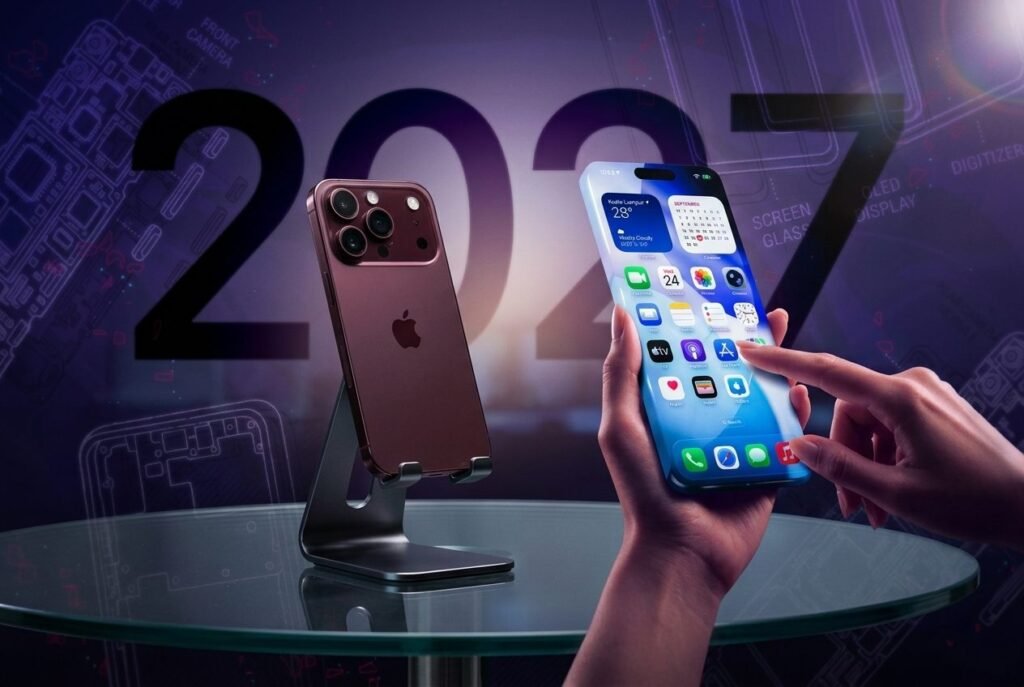
Here is where the genuinely new speculation lives, and where the latest iPhone rumors get genuinely interesting. The original iPhone went on sale on 29 June 2007, which makes 2027 the twentieth anniversary — and Apple has a documented history of marking round numbers with something unusual.
Will Apple Skip the iPhone 19?
Multiple independent sources behind the latest iPhone rumors now say yes. Korean outlet ETNews reported the naming jump first, and display-industry analyst Heo Moo-yeol of Omdia has since corroborated it. The precedent is obvious: in 2017 Apple shipped the iPhone 8 and the iPhone X in the same cycle and simply never produced an iPhone 9, because the X represented a big enough leap to warrant its own identity.
That said, the naming question is not settled. Several credible commentators think Apple could release an iPhone 19 base model alongside an “iPhone XX” Pro line, or abandon numbering altogether and simply call it “iPhone” the way it does with iPad and MacBook Air. Treat any confident claim about the 2027 name as an educated guess, not a fact.
The All-Glass Design Rumor
This is the most persistent thread in the latest iPhone rumors and also the shakiest. In May 2025 both Bloomberg and The Information described a mostly-glass, curved iPhone with no cutouts in the display at all — no notch, no Dynamic Island, and curved glass edges wrapping the entire chassis. Bloomberg’s Mark Gurman, whose Apple track record is stronger than anyone else’s in the business, has repeated the claim since.
ETNews added a further detail: four-sided bending on the display panel to produce a genuinely bezel-less, edge-to-edge front. Combined with Apple’s Liquid Glass design language across iOS, the direction is at least internally consistent.
The caveat is significant. In August 2026, Jefferies analyst Edison Lee claimed Apple had scrapped the all-glass project outright because of manufacturing yield problems. That report has not yet been corroborated by a second source, so it sits in limbo. If you are reading a site that presents the all-glass iPhone 20 as a done deal, it is not engaging with the full picture.
A21 Pro and Next-Generation Memory
The latest iPhone rumors point to the A21 Pro, built on a second-generation 2nm process — the natural successor to the A20 Pro that debuted this month. The more interesting claim concerns memory: several reports suggest Apple will move iPhone silicon toward a unified memory architecture closer to its M-series Mac chips.
That would matter enormously for on-device AI. Running a large language model locally is bottlenecked far more often by memory bandwidth and capacity than by raw compute. If Apple lands a unified-memory iPhone in 2027, the practical outcome is larger models running entirely on the handset — better offline Siri, faster image processing, and less reliance on Private Cloud Compute. For anyone tracking on-device AI in smartphones, this is the specification to watch.
Solid-State Buttons Are Back
Apple reportedly tested capacitive, non-mechanical buttons for the iPhone 15 Pro and abandoned them late in development. Weibo leaker Instant Digital claims they are back on the table for the iPhone 20, with volume, power and camera control switches replaced by pressure-sensitive pads driven by dedicated haptic engines.
The engineering benefit is water ingress: every physical button is a hole in the chassis. Remove all of them and, combined with eSIM-only design and a portless or USB-C-sealed body, you get a substantially more durable phone. The trade-off is that solid-state buttons do not work through thick gloves and are useless when the phone is powered off.
Silicon-Anode Battery Technology
Among the more grounded latest iPhone rumors, several leaks describe a silicon-based battery chemistry for the iPhone 20 line. Silicon-anode cells store meaningfully more energy per unit volume than conventional graphite-anode lithium-ion, which is why Chinese manufacturers have already shipped phones using the technology. Historically the problem has been swelling and degradation over charge cycles; if Apple has solved that at scale, it would allow either a genuinely thinner phone or a large real-world endurance gain without changing the dimensions.
Screen Sizes, Cameras and Modem
Gurman reported in June 2026 that Apple plans two iPhone 20 models in the Pro category for 2027, at approximately 6.3 inches and 6.9 inches — identical to the current 18 Pro and 18 Pro Max footprints. Leaks also mention an Apple-designed camera sensor, which would mark a break from the Sony sensors Apple has relied on for over a decade, and a C3 modem continuing the in-house cellular programme that began with the C1.
Under-display Face ID is the perennial rumor that never quite arrives. Some reports place the components beneath the screen for the iPhone 20, but Apple has already demonstrated an under-display FaceTime camera on the iPhone Duo, so the technology clearly exists inside the company. Whether the full TrueDepth array — dot projector, flood illuminator, infrared camera — can hide under an OLED panel at acceptable accuracy is a different engineering problem entirely.
Spring 2027: iPhone 18, iPhone 18e and iPhone Air 2
The mainstream half of the lineup is where most buyers actually live, and the latest iPhone rumors here are unusually consequential.
The standard iPhone 18 is expected in spring 2027 with the A20 chip — one tier below the A20 Pro — and the design language established by the 17 and 18 Pro. The iPhone 18e continues the budget line that replaced the SE, and is likely to keep a single rear camera and a smaller battery to hit its price point.
The iPhone Air 2 is the most contested device on the roadmap. The original iPhone Air launched in September 2025 and underperformed against Apple’s expectations, which led to reports that the sequel had been pushed to spring 2027. A subsequent leak from tipster Fixed Focus Digital on Weibo claimed it was back on track for autumn 2026 — a claim the September keynote disproved. Current consensus places it in spring 2027, with Apple reportedly exploring a second rear camera to justify its roughly $999 asking price.
If you want the lay of the land on the current generation before deciding, our iPhone 18 Pro vs iPhone 17 Pro comparison breaks down whether the upgrade is worth it today.
iPhone Duo 2 and the Foldable Roadmap
Apple shipped a first-generation foldable, and first-generation Apple products are almost always followed by a rapid second revision that fixes the obvious gaps. The gaps here are well identified: no telephoto camera, a crease that Apple has minimised but not eliminated, Touch ID instead of Face ID on some configurations, and a starting price that puts it beyond mainstream reach.
Market context matters too. IDC analyst Francisco Jeronimo projects foldables at 2.2% of global smartphone units in 2026, rising to only 3.1% by 2030 — but because average selling prices are so high, they represent around 6.9% of revenue in 2026 and roughly 10% by 2030. Apple does not need volume here; it needs margin. That suggests the Duo line will be iterated steadily rather than pushed aggressively downmarket.
Competitively, Apple entered at $1,999 against the Galaxy Z Fold 8 at $1,899 and the Z Fold 8 Ultra near $2,099. In China, however, Huawei dominates — accounting for roughly 79% of foldable units and 82% of foldable revenue in the second quarter of 2026. Apple’s foldable ambitions will be tested hardest in exactly the market where it can least afford to lose ground.
iOS 27, Apple Intelligence and Software Rumors
Hardware gets the headlines in most latest iPhone rumors coverage, but software rumors increasingly drive purchase decisions. iOS 27 shipped alongside the iPhone 18 Pro in September 2026, extending the Liquid Glass interface introduced the previous year across more system surfaces.
The recurring rumor worth tracking concerns Siri. Apple’s assistant overhaul has slipped repeatedly, and reporting through 2025 and 2026 has described a rebuilt architecture capable of app-level actions and genuine conversational context. Some of that has shipped; much of it has not. Expect the 2027 cycle to be judged heavily on whether the assistant finally matches what was demonstrated on stage years earlier.
A second thread involves regulatory pressure. The EU’s Digital Markets Act has already forced sideloading and alternative app stores in Europe, and ongoing legal action in the United States could extend similar requirements. Any rumor about default-app freedom, third-party assistant access or NFC opening up is worth reading with one eye on the courts rather than on Cupertino.
iPhone Price Rumors: What to Expect in 2027
The 2026 cycle was supposed to be brutal on pricing. A global memory shortage pushed component costs up sharply through the year, and Apple had already raised prices on Macs and iPads in anticipation. Analysts widely expected $200 increases on the Pro line.
What actually happened was a $100 rise on each Pro model, and a price cut elsewhere in the lineup — AirPods 5 brought active noise cancellation to a $129 entry point, below the $179 the noise-cancelling AirPods 4 commanded in 2024. The lesson for anyone reading the latest iPhone rumors is that analyst cost modelling frequently overstates what Apple passes to consumers, because Apple absorbs component volatility to protect unit volume.
| Model | Launch Price (USD) | Storage Range |
|---|---|---|
| iPhone 18 Pro | $1,199 | 256GB – 2TB |
| iPhone 18 Pro Max | $1,299 | 256GB – 2TB |
| iPhone Duo | $1,999 – ~$3,199 | 256GB – 2TB |
| iPhone 18 (rumored) | ~$899 est. | TBC |
| iPhone 18e (rumored) | ~$599 est. | TBC |
For 2027, the reasonable expectation is stability rather than escalation on the Pro line, with the anniversary model potentially carrying a premium if the all-glass design survives to production. Estimated figures above are projections, not leaks.
How Reliable Are the Latest iPhone Rumors? A Source Guide
Not all of the latest iPhone rumors deserve equal weight. After following this cycle for years, a rough reliability hierarchy emerges — and knowing it is the single most useful skill for reading Apple coverage.
- Tier 1 — Supply chain and financial reporting. Mark Gurman at Bloomberg, and reporting from The Information, Nikkei Asia and The Wall Street Journal. These are sourced from people inside Apple or its manufacturing partners. Gurman’s hit rate on product existence and timing is very high; his hit rate on final naming is lower, because Apple often decides names late.
- Tier 2 — Display and component analysts. Ming-Chi Kuo, Omdia, Display Supply Chain Consultants, Jefferies. Excellent on panel sizes, chip processes and production volumes. Weaker on software features, which never touch the supply chain.
- Tier 3 — Established Apple publications. MacRumors, 9to5Mac, AppleInsider. These rarely break stories themselves but are careful aggregators who flag source reliability and correct themselves publicly.
- Tier 4 — Weibo and X leakers. Instant Digital, Fixed Focus Digital, Digital Chat Station. Occasionally first with accurate component details. Also occasionally wrong in ways that propagate across hundreds of sites within hours.
- Tier 5 — Render farms and concept accounts. Beautiful images, almost zero informational value. A CAD render based on a leaked case mould tells you about a case mould, not about Apple’s final design.
Two practical rules follow from this. First, a rumor with a single source is a hypothesis, not a fact — the scrapped-all-glass-display report is a live example. Second, the closer a claim sits to physical manufacturing, the earlier and more accurately it leaks; the closer it sits to software and branding, the later and less reliably.
Should You Buy Now or Wait? An Honest Assessment
This is the question the latest iPhone rumors are really being read to answer, so here is a direct framework rather than a hedge.
Buy the iPhone 18 Pro now if…
- You are on an iPhone 14 Pro or older. The generational gap in chip, camera and battery is large enough to feel daily.
- You shoot a lot of photography and want mechanical aperture control.
- Your current phone has a degraded battery or a cracked screen — repair costs frequently exceed the value of waiting.
- You are on a carrier plan where trade-in credit is time-limited.
Wait until spring 2027 if…
- Your budget is under $1,000. There is simply no new standard model available right now.
- You are on an iPhone 16 or 17 and your battery health is still above roughly 85%.
- You want the iPhone Air form factor specifically.
Wait until autumn 2027 if…
- You upgrade rarely and want the design that will define the next five years.
- The all-glass, buttonless direction is what you actually want — accepting that it may not ship.
- You are interested in serious on-device AI and want the unified-memory architecture.
The uncomfortable truth about waiting for rumored hardware is that there is always a better phone twelve months away. A device you can use for eighteen months starting today usually beats one you can use for twelve months starting next autumn.
How Apple’s Roadmap Compares to Samsung and Google
Context sharpens any rumor, and the latest iPhone rumors are best read against what rivals are already shipping. Samsung’s Galaxy S26 Ultra currently sits around $961 — roughly $238 below the iPhone 18 Pro — while offering an S Pen and a built-in privacy display. Samsung is already several generations into foldables with the Galaxy Z Fold 8 and Z Fold 8 Ultra. Google continues to push computational photography and Gemini integration on the Pixel line.
Apple’s advantage has never been being first. It was eight years late to foldables, several years late to large screens, and late to high refresh rates. What it historically does is arrive with better durability engineering, longer software support, and tighter hardware-software integration. Whether that pattern holds for the Duo is the most interesting open question of 2027 — and it is the reason iPhone 20 rumors are being scrutinised so intensely.
For a side-by-side of the current flagships, see our best flagship smartphones of 2026 roundup.
How to Follow the Latest iPhone Rumors Without Getting Misled
- Check the original source, not the aggregator. Most rumor articles cite another article. Follow the chain to its origin before believing anything.
- Note the date. Apple roadmaps shift constantly. A claim from 2025 about a 2027 device may have been superseded three times.
- Distinguish “Apple is testing” from “Apple will ship.” Apple prototypes many features it never releases. Solid-state buttons were tested and cancelled once already.
- Be sceptical of render-driven articles. If the evidence is an image rather than a source, treat it as illustration.
- Wait for corroboration. One outlet is a lead. Two independent outlets with separate sourcing is a story.
Frequently Asked Questions About the Latest iPhone Rumors
What is the next iPhone after the iPhone 18 Pro?
The next devices expected are the standard iPhone 18 and iPhone 18e in spring 2027, followed by the 2027 flagship line in September 2027 — which multiple reports suggest will be named iPhone 20 rather than iPhone 19.
Is Apple really skipping the iPhone 19?
It appears likely but is not confirmed. ETNews reported it first and Omdia has corroborated it, with the reasoning being the iPhone’s twentieth anniversary in 2027. Apple has done this before, skipping the iPhone 9 in favour of the iPhone X in 2017.
When will the iPhone 20 be released?
If Apple follows its normal pattern, announcement would come in early September 2027 with retail availability one to two weeks later. For reference, the iPhone 18 Pro was announced 9 September 2026 and released 18 September 2026.
Will the iPhone 20 have an all-glass design?
Unclear. Bloomberg and The Information reported a curved, cutout-free all-glass design, but Jefferies analyst Edison Lee claimed in August 2026 that the project was cancelled over manufacturing yield problems. That cancellation report has not been independently confirmed.
How much does the iPhone Duo cost?
The iPhone Duo starts at $1,999 for 256GB and rises to roughly $3,199 at 2TB, making it the most expensive iPhone Apple has ever sold. It became available on 23 October 2026.
Why is there no standard iPhone 18 in 2026?
Apple has moved to a split release cadence. Premium models — iPhone 18 Pro, Pro Max and the Duo — launched in autumn 2026, while the standard iPhone 18, iPhone 18e and iPhone Air 2 are expected in spring 2027.
Will the iPhone 20 have solid-state buttons?
Weibo leaker Instant Digital claims Apple is developing non-mechanical, haptic-driven buttons to replace volume, power and camera controls. Apple tested and abandoned this approach for the iPhone 15 Pro, so treat it as plausible rather than probable.
Which chip will the iPhone 20 use?
Leaks point to an A21 Pro built on a second-generation 2nm process, succeeding the A20 Pro. Some reports also suggest a shift toward unified memory similar to Apple’s M-series Mac silicon, which would significantly benefit on-device AI.
Is the iPhone Air discontinued?
No. The iPhone Air 2 did not appear in September 2026, but current reporting places it in spring 2027, potentially with a second rear camera added to strengthen its value proposition.
Are iPhone rumors usually accurate?
Hardware rumors sourced from the supply chain are frequently accurate on specifications and timing. Naming, pricing and software features leak far less reliably. The 2026 cycle illustrated this well: leaked specs largely held up, but the foldable’s name, display size and final pricing all differed from pre-event reports.
Key Takeaways
- Apple launched the iPhone 18 Pro ($1,199), iPhone 18 Pro Max ($1,299) and its first foldable, the iPhone Duo ($1,999), in autumn 2026.
- There is no standard iPhone 18 this autumn; it moves to spring 2027 alongside the 18e and iPhone Air 2.
- The 2027 flagship is widely expected to be named iPhone 20, skipping 19 to mark the twentieth anniversary.
- Rumored iPhone 20 features include an all-glass cutout-free design, A21 Pro silicon, solid-state buttons, an Apple-designed camera sensor and silicon-anode batteries.
- The all-glass design may have been cancelled over yield problems — a single-source report awaiting corroboration.
- Weigh rumors by source tier. Supply-chain reporting is reliable; renders and single-source leaks are not.
Final Verdict
The latest iPhone rumors describe the most interesting two-year stretch Apple has had since 2017. A split release calendar, a genuinely new form factor, a naming change tied to an anniversary, and a redesign that may or may not survive manufacturing — that is a lot of moving parts for a company usually characterised by predictable annual iteration.
What has not changed is how to read any of it. Weight your sources. Wait for corroboration. Separate what Apple has confirmed from what a supply-chain analyst inferred from a panel order. And remember that the phone in your pocket today does not become worse because a better one is rumored for next year.
We update this page whenever credible new reporting emerges. Bookmark it, and check back as the 2027 cycle comes into focus.
Sources and Further Reading
- MacRumors — iPhone 18 Roundup
- MacRumors — Apple’s 20th Anniversary iPhone
- AppleInsider — iPhone 20 Rumors and Features
- 9to5Mac — Three New iPhones Launch
- GSMArena — iPhone 20 Series to Launch in 2027
- Notebookcheck — Omdia on Apple Skipping iPhone 19
- Digital Trends — September 2026 Event Guide
- BGR — Apple May Skip the iPhone 19
- Apple Newsroom — Official Announcements