Coinbase has taken its first formal regulatory step toward offering single-stock perpetual futures to US customers, filing two notice registrations with the Securities and Exchange Commission on September 1, 2026. If approved, the move would let American investors trade perpetual-style contracts tied to individual stocks like Apple, Microsoft, and Nvidia — a product already available to Coinbase customers outside the United States.
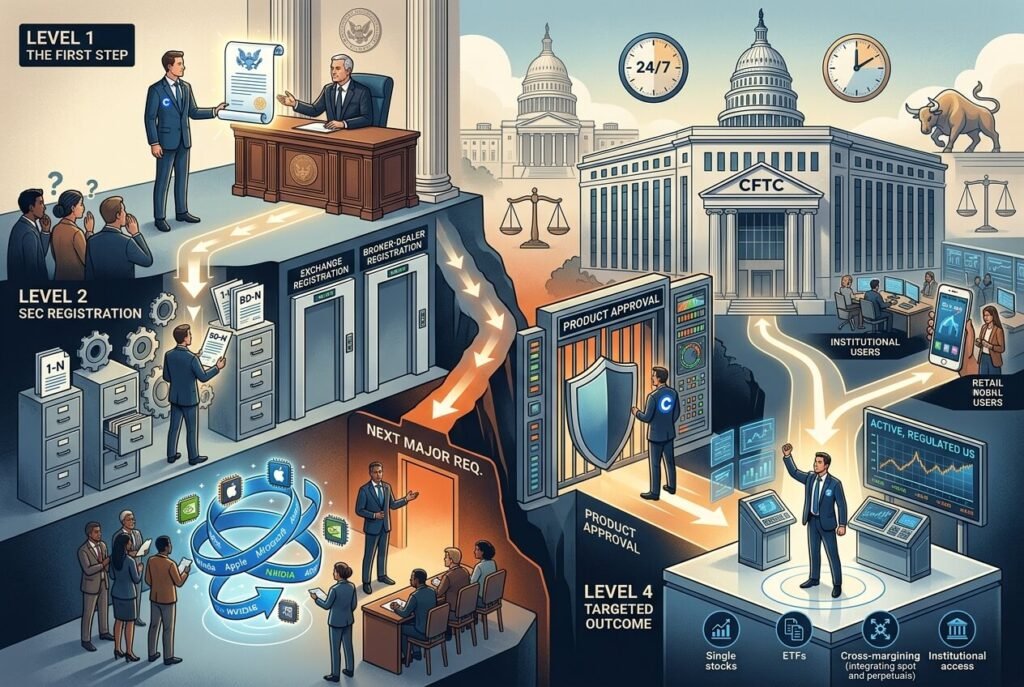
The filing is an early procedural step rather than a finished product launch. Coinbase’s Chief Policy Officer, Faryar Shirzad, described it as a first step, noting that approval from the Commodity Futures Trading Commission is the company’s next major requirement before any single-stock perpetual could actually go live domestically.
What Happened? Coinbase’s SEC Filing Explained
The filing packet includes a Form 1-N for Coinbase Derivatives LLC and a Form BD-N for Coinbase Financial Markets Inc., both dated September 1, 2026. The Form 1-N is used for notice registration as a national securities exchange solely for trading security futures products, while the BD-N registers Coinbase Financial Markets as a security-futures-product broker-dealer. Coinbase Financial Markets is already registered as a futures commission merchant, meaning it currently facilitates customer trading of listed derivatives on designated US contract markets.
Notably, the two-page filing packet does not specify which individual stocks would be offered or which categories of US customers might eventually qualify to trade them. It simply establishes the regulatory registrations Coinbase needs to move forward.
This filing extends a product Coinbase already offers overseas. Since March 2026, the company has allowed eligible customers outside the US to trade single-stock perpetual futures covering Apple, Microsoft, Alphabet, Amazon, Nvidia, Meta, and Tesla, along with contracts tracking the SPY and QQQ exchange-traded funds where permitted. Inside the US, Coinbase currently offers only broader, thematic perpetual-style futures tracking baskets of stocks — such as artificial intelligence, China, defense, and top technology names — rather than individual companies.
Why It Matters
Perpetual futures, commonly called “perps,” are derivative contracts with no expiration date that let traders speculate on an asset’s price movement without owning the underlying asset directly. They have been a dominant trading product on offshore, largely unregulated crypto exchanges for years, but have remained mostly unavailable to US traders due to regulatory restrictions.
That began changing in May 2026, when the CFTC’s Division of Market Oversight granted approval for KalshiEX and Coinbase to list bitcoin perpetual futures contracts in the US — the first time this contract type had been formally approved for the American market. A month later, the CFTC issued a request for public comment on extending the perpetual contract model to crude oil and to 24/7 trading more broadly, signaling regulators were open to expanding the concept beyond crypto assets.
Coinbase’s push to bring single-stock perpetuals onshore represents the next logical step in that expansion — moving a popular but historically offshore trading product into a regulated US framework, and extending it from cryptocurrencies into traditional equities.
How It Works: The Path to Approval
Under current US derivatives regulation, launching a new perpetual futures product generally requires sign-off from the CFTC, since these contracts are classified as futures rather than securities in most cases. Coinbase’s SEC filings are a necessary registration step, but the CFTC’s product approval process — which the company has flagged as its next step — will determine whether and when single-stock perpetuals can actually be offered to US customers.
This layered regulatory approach reflects the unusual position these products occupy: they involve individual equities (traditionally SEC territory) structured as perpetual futures contracts (traditionally CFTC territory), requiring coordination between both regulators.
Key Benefits
Regulated access to a popular product: US traders would gain a domestic, regulated alternative to offshore perpetual futures platforms that currently operate outside US oversight.
Expanded product lineup: Coinbase’s US derivatives offering would grow from thematic stock-basket contracts to individual, well-known companies.
Leverage and flexibility: Internationally, Coinbase’s stock perpetuals have offered leverage up to 10x on individual stocks and up to 20x on ETFs, along with cross-margining across spot and perpetual positions.
Institutional and retail reach: A successfully approved product could serve both retail traders seeking equity exposure outside standard market hours and institutions looking for flexible derivatives exposure.
Risks and Challenges
The approval process is neither quick nor guaranteed. The SEC filing is only the first of at least two major regulatory steps, and CFTC approval for new derivatives products — particularly ones tied to individual equities rather than commodities or broad indexes — can involve extended review periods and additional conditions.
There are also structural risks associated with perpetual futures generally: because these contracts never expire and typically offer meaningful leverage, they can expose retail traders to significant losses relative to their initial investment, particularly during periods of high volatility in the underlying stock.
Regulatory uncertainty also remains a factor. While the CFTC has shown increasing openness to perpetual-style contracts — as seen with its bitcoin perpetuals approval and subsequent request for comment on crude oil perpetuals — there is no guarantee the same reasoning will extend smoothly to single-stock products, which touch more directly on securities market structure and investor protection concerns typically overseen by the SEC.
What It Means for Businesses and Consumers
For retail and institutional traders, approval would mean a new, US-regulated way to gain leveraged exposure to individual stock price movements without the counterparty and regulatory risks associated with offshore trading platforms. For Coinbase, successful approval would meaningfully expand its US derivatives business beyond crypto assets and thematic stock baskets into a much larger addressable market: trading on individual, widely held US companies.
For the broader brokerage and exchange industry, Coinbase’s push could accelerate competitive pressure on other platforms to pursue similar products, particularly as CFTC precedent around perpetual contracts continues to build.
What Happens Next?
Coinbase’s next step is securing CFTC product approval, a process with no publicly disclosed timeline as of the filing date. Given the CFTC’s recent history — approving bitcoin perpetuals in May 2026 and opening a comment period on crude oil perpetuals shortly after — the regulatory environment appears more receptive than it has been historically, though single-stock products may draw additional scrutiny given their direct ties to individual public companies.
Key Takeaways
Coinbase filed two SEC notice registrations on September 1, 2026, seeking to offer single-stock perpetual futures to US customers.
The filing does not name specific stocks or eligible customer categories; those details are expected in later stages.
CFTC product approval is the next required step before any single-stock perpetual product can launch domestically.
Coinbase already offers single-stock perpetuals, including on Apple, Microsoft, and Nvidia, to eligible customers outside the US.
The move follows the CFTC’s May 2026 approval of bitcoin perpetual futures for US traders, the first of its kind.
Coinbase’s SEC filing is an early but meaningful step toward bringing a widely used offshore trading product into the regulated US market. Whether single-stock perpetuals actually reach American traders will depend heavily on how the CFTC responds — but the filing itself reflects a broader trend of US regulators warming to derivative structures that were once considered too novel, or too risky, for domestic markets.