
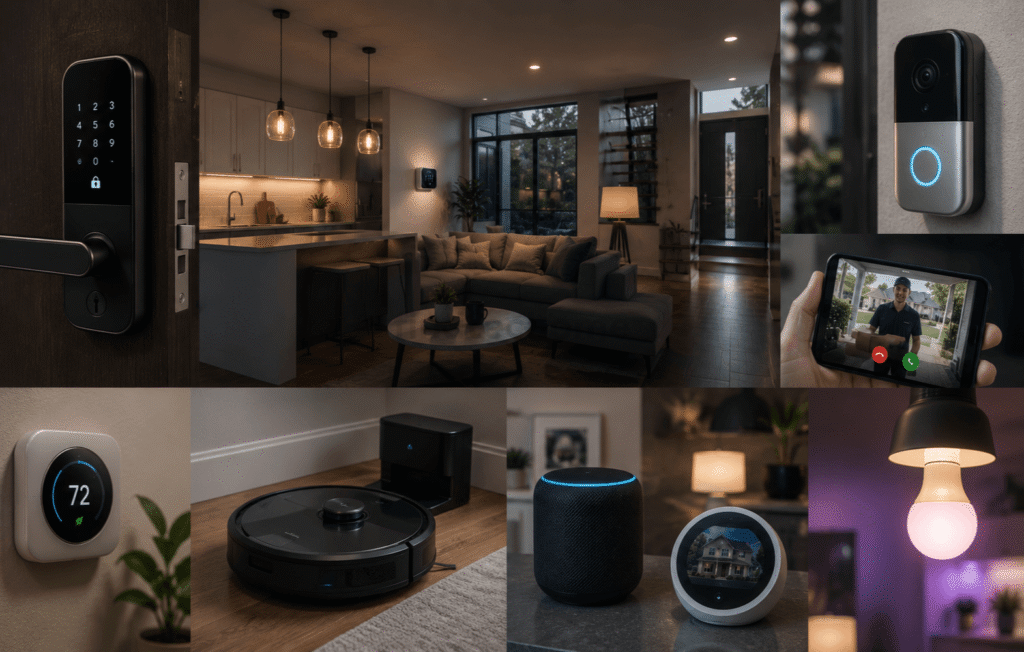
Smart home gadgets have a reputation for being more gimmick than genuinely useful, a smart fork or a Wi-Fi connected toaster that adds an app for the sake of adding an app. A smaller number of categories, though, have matured past the novelty stage and now solve real, everyday problems well enough to justify the cost and the setup hassle. The difference usually comes down to whether a device reduces friction in daily life or simply moves an existing task onto a phone screen.
Smart locks and video doorbells
A smart lock that grants temporary codes to a dog walker or a house sitter, and logs exactly when the door was opened, solves a problem that has no easy low tech equivalent short of hiding a spare key. Paired with a video doorbell, it also answers the most common home security question, who was at the door, without requiring a person to be home to see it happen. This category has matured to the point where reliability, not novelty, is now the main differentiator between brands, which makes it one of the safer smart home purchases for someone trying it for the first time.
Smart thermostats
A thermostat that learns a household schedule and adjusts heating or cooling automatically tends to pay for itself over a few years through lower energy bills, particularly in homes where nobody remembers to manually adjust the temperature before leaving for work. Unlike many smart home categories, the value here does not depend on a person actively engaging with an app; the savings happen passively once it is set up, which is part of why this remains one of the most consistently recommended smart home upgrades.
Robot vacuums with real mapping
Early robot vacuums bounced around rooms somewhat randomly and needed frequent rescue from under furniture. Current models with proper room mapping and obstacle avoidance clean predictably enough that many owners genuinely stop vacuuming manually for routine maintenance, reserving deeper manual cleaning for occasional deep cleans. The gap between a budget model and a well reviewed mid range one is large enough in this category that research before buying matters more than in most smart home purchases.
Where to be skeptical
Smart kitchen appliances, connected mirrors, and most smart lighting beyond basic on and off scheduling still tend to add complexity without a proportional benefit for most households. A useful test before buying any smart home device is whether it would still be worth using if the app broke tomorrow and only the basic hardware function remained; devices that pass that test tend to be the ones that earn a permanent place in a home rather than getting unplugged after the novelty wears off.