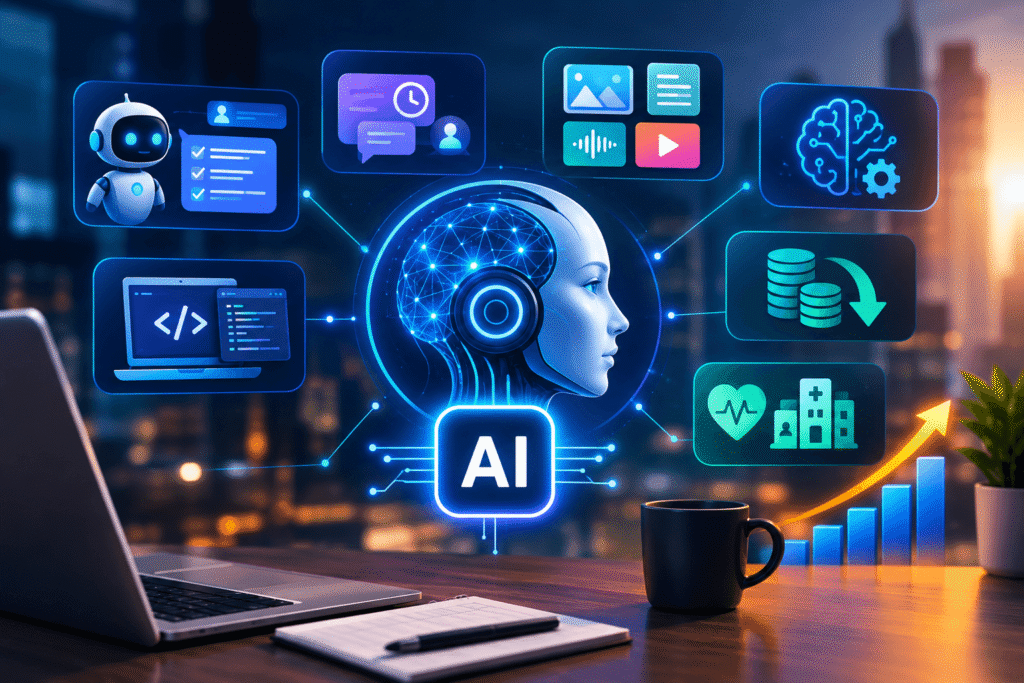
Artificial intelligence continues to evolve at a breakneck pace, and September 2026 has emerged as something of a checkpoint moment for the industry. The hype cycle that defined the early years of the generative AI boom hasn’t disappeared, but the underlying buying logic and technical priorities have shifted noticeably. Rather than chasing flashier chat interfaces or louder vendor promises, businesses, developers, and consumers alike are increasingly focused on AI systems that deliver measurable, connected value across real workflows. Here’s a closer look at the trends defining the AI landscape right now.
1. Agentic AI Becomes the Real Unit of Value
Perhaps the most significant shift this year has been the move away from isolated, single-purpose AI tools and toward orchestrated, agentic systems capable of handling multi-step tasks with minimal human intervention. Modern AI agents can now research topics, draft documents, sort and route support tickets, parse complex documents, and move work seamlessly across different software applications — capabilities that would have required custom-built automation pipelines just a couple of years ago.
Crucially, though, industry analysts note that the most successful implementations still keep humans firmly in the loop for high-stakes decisions. Pricing, legal commitments, hiring decisions, and brand-sensitive customer communications remain areas where human approval continues to be considered essential, even as AI increasingly handles the drafting, sorting, and preliminary decision-making that used to consume the bulk of a team’s time. This “human-supervised agent” model has emerged as the practical middle ground between fully autonomous AI systems and traditional, entirely manual workflows.
2. Persistent, Context-Aware Assistants
Another defining trend of 2026 is the rise of persistent AI assistants that retain memory and context across sessions, rather than starting from scratch with every new conversation. These systems are increasingly capable of remembering a business’s specific processes, a user’s ongoing projects, and prior customer interactions, which significantly reduces the repetitive setup and re-explaining that plagued earlier generations of AI tools.
This shift toward persistent memory has particular significance for small teams and individual professionals, who can now access a level of operational support that previously required larger dedicated staff. Instead of a one-off chatbot interaction, these systems increasingly function more like a junior team member capable of tracking ongoing work across sales, customer support, content creation, and general operations.
3. Multimodal AI Becomes the Default, Not the Exception
Multimodal capability — the ability of an AI system to process and reason across text, images, audio, and even video within a single workflow — has moved from a nice-to-have feature to a baseline expectation among frontier AI models. This shift matters significantly for practical business use cases, since real-world work rarely arrives as clean, isolated text. Systems that can read screenshots, scanned documents, PDFs, audio recordings, and video content in one continuous workflow are proving far more useful across functions like sales support, legal review, employee training, and general business operations than text-only tools ever were.
4. Reasoning Models Trade Speed for Accuracy
On the pure model-capability side, one of the clearest technical trends has been the continued rise of dedicated reasoning models, which prioritize deeper, more deliberate problem-solving over raw response speed. These models are increasingly favored for complex analytical tasks where accuracy matters more than instantaneous output, marking a shift away from the earlier industry focus on ever-faster response times as the primary competitive differentiator.
5. Falling Inference Costs Are Reshaping Competition
A less visible but arguably more consequential trend has been the continued, dramatic decline in the cost of running AI models — inference costs have reportedly fallen at a rate of roughly tenfold per year for comparable levels of capability. This steep cost curve has meaningfully changed the competitive landscape. Rather than competing primarily on raw model quality, which has become increasingly commoditized, companies are now differentiating themselves through process design, proprietary data ownership, user trust, and speed of deployment.
This cost decline has also fueled the growing popularity of smaller, open-weight models, which are increasingly closing the capability gap with larger proprietary systems while offering businesses greater control, lower operating costs, and better suitability for private or highly specialized sector-specific tasks.
6. Healthcare Emerges as a Leading AI Investment Category
Among AI-focused startups launching new products this month, healthcare has emerged as a particularly active category, spanning remote patient care, provider operations tools, hospital administrative systems, pediatric support tools, and at-home diagnostic testing technology. The logic behind this concentration of investment is straightforward: hospitals and care providers are willing to pay meaningfully for tools that reduce the burden of documentation, patient triage, scheduling, and staffing pressures — problems that are both expensive and persistent across the healthcare industry.
7. AI Coding Agents Continue to Mature
Software development remains one of the sectors most visibly transformed by agentic AI in 2026. Modern AI coding agents have moved well beyond simple autocomplete functionality, now capable of understanding entire codebases, editing across multiple files simultaneously, running automated tests, investigating and diagnosing errors, and supporting long-running engineering workflows with minimal developer oversight for routine tasks. This category has become increasingly competitive, with numerous specialized platforms now available spanning autonomous coding agents, AI-native development environments, terminal-based tools, and dedicated evaluation platforms for testing AI-generated code.
What This Means Going Forward
Taken together, these trends paint a picture of an AI industry that’s maturing rapidly beyond its earlier hype-driven phase. The core message from analysts and industry observers heading into the final months of 2026 is consistent: the businesses and individuals extracting the most genuine value from AI right now are those focused on solving specific, well-defined workflow problems rather than simply chasing the latest headline-grabbing model release.
For businesses evaluating how to incorporate AI more deeply into their operations, the emerging consensus suggests a disciplined approach: identify a single expensive or repetitive business process, test the lightest viable AI-powered solution against it, measure the results carefully, and only expand further once clear, measurable gains have been demonstrated. As the technology continues to evolve at pace, that kind of grounded, outcome-focused approach is increasingly being seen as the difference between AI investments that deliver real returns and those that amount to little more than expensive experimentation.