Dyson, the British engineering company best known for its vacuums, hair dryers, and air purifiers, has officially entered an entirely new product category: oral care. The company’s newly launched CameraJet toothbrush combines an electric toothbrush, a precision water flosser, and a built-in camera powered by machine learning, all wrapped into a single $499.99 device that’s already generating enormous buzz — and no shortage of skepticism — across the tech world.
What Makes the CameraJet Different
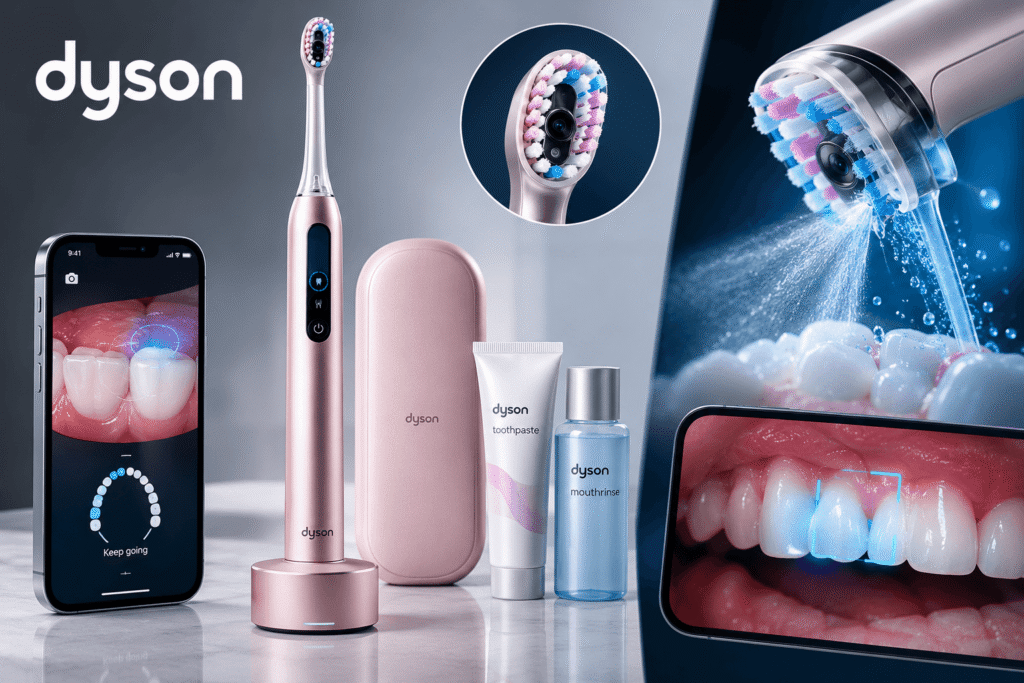
At the heart of the CameraJet’s design is a tiny 100,000-pixel macro-lens camera embedded directly into the brush head, capable of capturing 28 images per second as it moves across the user’s teeth. Those images are processed in real time by a proprietary machine-learning system Dyson calls Gap Optical Targeting, which is designed to detect, track, and predict the interdental gaps between teeth — the spaces traditional brushing often struggles to clean effectively.
When the system identifies a gap, it triggers a precisely targeted burst of mouthrinse, delivered in roughly 100 milliseconds, effectively flossing between the teeth while the user brushes in a single combined motion. Unlike traditional water flossers, which typically produce a thin, needle-like stream of liquid, the CameraJet instead delivers a cone-shaped spurt of mouthwash designed to cover a wider surface area of the tooth for a deeper, gentler clean without excessive pressure on the gums or enamel. An “anti-gravity” tank built into the base of the brush head is engineered to keep the rinse flowing consistently regardless of whether the device is held upright, horizontally, or at an angle.
The brush itself uses sonic oscillation technology, vibrating nearly 1,000 times per second, and features two different bristle lengths designed to better hug the natural contours of each tooth. The included charging dock can fully refill the device’s 12.5-milliliter mouthrinse tank in about three seconds, according to Dyson.
Connecting to the MyDyson App
For users who want a more detailed look at their brushing habits, the CameraJet connects via Wi-Fi to the MyDyson companion app, which offers a live video feed from inside the user’s mouth while brushing, along with guided cleaning instructions, coverage mapping to highlight missed areas, and personalized technique feedback over time.
Given the somewhat unusual prospect of livestreaming footage from inside your own mouth, privacy has understandably been a major point of interest and concern among early coverage of the device. Dyson has stated that the camera is only active during live viewing sessions or automatic jetting operation, and that images captured by the device are not recorded or stored, either on the toothbrush itself or in the cloud. The company has emphasized that the camera’s core function is real-time gap detection and rinse targeting rather than data collection or storage, positioning the feature primarily as a functional hygiene tool rather than a smart-home surveillance device.
Six Years, 661 Engineers, and 38 Patents
According to Dyson founder and chief engineer James Dyson, the CameraJet represents roughly six years of development work, involving 661 engineers and drawing on more than 470,000 dental images used to train the underlying machine-learning system, all built on top of an estimated 16 million lines of code. The company has also filed 38 patents connected to the device, underscoring just how significant an engineering investment this product category expansion represents for a company traditionally associated with vacuums and hair care tools.
Dyson has said the motivation behind the CameraJet stemmed from a very ordinary problem: a general dislike of flossing. While water flossers have existed as an alternative for years, Dyson has argued that many existing devices fall short in effectively targeting and cleaning between teeth, prompting the company to apply its broader expertise in engineering and, increasingly, artificial intelligence, toward solving the problem more precisely.
Clinical Testing and Early Evidence
Dyson has pointed to a six-week clinical study involving 204 participants, which the company says found the CameraJet more effective at improving gum health compared to a standard manual toothbrush. However, some independent oral health commentary has urged a degree of caution around these kinds of claims more broadly. A previous Cochrane review examining oral irrigators and water flossers more generally found the existing evidence base for these devices to be somewhat limited and inconsistent, suggesting that while such tools can be a helpful addition to an oral care routine for some users, they aren’t necessarily a guaranteed replacement for more traditional flossing methods across the board.
Pricing, Availability, and What’s in the Box
The Dyson CameraJet officially went on sale on September 1, 2026, in the United States, with equivalent listings also available in the United Kingdom, France, Australia, and Japan. The complete Dyson Dental System package, priced at $499.99, includes the CameraJet toothbrush itself, a charging dock, a travel case, and supplies of Dyson-branded toothpaste and mouthrinse. The device is available in two colorways: Ceramic Pink and Ceramic Ultra Blue.
Why This Launch Is Trending in Tech Circles
The CameraJet’s combination of a premium price tag, an unconventional feature set, and Dyson’s broader reputation for high-design, high-cost consumer engineering has made it one of the more talked-about product launches of early September 2026, appearing prominently in trending searches with over 200,000 searches and a roughly 500 percent increase in interest. It follows a now-familiar pattern for Dyson, whose entries into other personal care categories — including its Supersonic hair dryer line — have similarly generated significant buzz and debate over whether their premium pricing is justified by genuine performance gains.
The CameraJet also arrives at a moment when artificial intelligence and machine-learning features are increasingly being embedded into everyday consumer hardware, from toothbrushes to kitchen appliances, reflecting a broader industry trend of manufacturers looking for ways to differentiate traditionally low-tech product categories through smart, connected features.
The Verdict So Far
Early reactions to the CameraJet have been mixed but engaged, ranging from genuine curiosity about its dental health benefits to skepticism about whether a smart, camera-equipped toothbrush is a meaningful innovation or simply an expensive novelty. What’s clear, though, is that Dyson has succeeded in generating significant conversation around a product category that rarely makes tech headlines — proof, once again, that the company’s ability to reinvent mundane household objects into premium, talked-about gadgets remains very much intact.