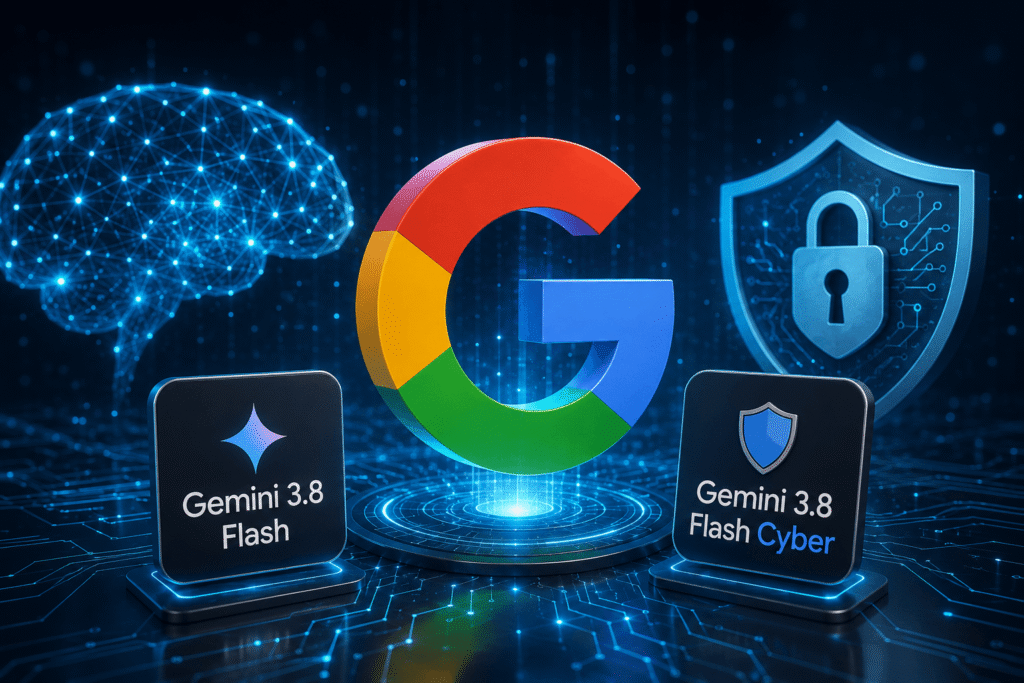
Google released two new AI models on September 2, 2026: Gemini 3.8 Flash, a general-purpose reasoning and coding model, and Gemini 3.8 Flash Cyber, a specialized variant built for finding and fixing software vulnerabilities. Together, they mark Google’s third Flash-tier release in just six weeks.
The pace of releases highlights how aggressively Google is iterating on its lightweight Flash models, even as its next major flagship, Gemini 3.5 Pro, remains in development following its announcement at Google I/O in May 2026.
While Gemini 3.8 Flash is broadly available to developers and consumers, Gemini 3.8 Flash Cyber is being kept behind a new restricted-access program aimed at governments and trusted security partners.
What Happened? Google’s Latest Gemini Release Explained
Google describes Gemini 3.8 Flash as its “most intelligent workhorse model,” built to improve on software engineering, agentic tasks, and multi-step reasoning compared with its predecessor, Gemini 3.7 Flash, which launched only three weeks earlier. The model is generally available under the model ID gemini-3.8-flash and can be accessed through the Gemini app, AI Mode in Google Search, Gemini in Google Sheets, and via API for developers.
Gemini 3.8 Flash Cyber, meanwhile, is tuned specifically for cybersecurity work — discovering vulnerabilities and generating patches with minimal human input. Google says the model outperforms its predecessor, 3.5 Flash Cyber, as well as some significantly larger frontier models on security-specific tasks. According to Google, Chrome’s internal security team found that 3.8 Flash Cyber produced substantially more correct vulnerability patches than earlier tools. Access to the Cyber variant is limited to Google’s new Fairwind Program, created for governments and trusted defenders.
Both models were built on the same underlying system, which Google says was refined through long-running agentic training loops that recursively evaluate and improve performance, including specialized cybersecurity training.
Why It Matters
The release reflects two converging trends in AI development: a shift toward frequent, incremental model updates rather than infrequent, major overhauls, and a growing focus on using AI directly for cybersecurity defense rather than treating it purely as a productivity tool.
Google’s three Flash releases in six weeks — following Gemini 3.6 Flash in late July and Gemini 3.7 Flash roughly three weeks later — show a company prioritizing rapid, continuous improvement of its lower-cost tier while it continues refining its top-tier Pro model behind the scenes.
The Cyber variant’s restricted rollout also signals how seriously AI labs are treating the dual-use risk of vulnerability-discovery tools: a model capable of finding and patching security flaws could, in the wrong hands, be used to find and exploit them instead.
How It Works: Pricing and Availability
Gemini 3.8 Flash keeps the same introductory pricing as its predecessor: $0.75 per million input tokens and $3.75 per million output tokens, available through December 31, 2026. Standard pricing takes effect on January 1, 2027, rising to $1.50 per million input tokens and $7.50 per million output tokens.
On benchmark performance, Google reported a 73.7% score for Gemini 3.8 Flash on DeepSWE v1.1, a test measuring autonomous software engineering ability, placing it ahead of Gemini 3.7 Flash and close to some larger, more expensive frontier models.
Gemini 3.8 Flash Cyber is not available through standard consumer or developer channels. Instead, access is granted through the Fairwind Program, which Google has positioned as a controlled pathway for governments and vetted security organizations to use the model for defensive work.
Key Benefits
Stronger coding performance at low cost: Gemini 3.8 Flash reportedly rivals larger, pricier frontier models on engineering benchmarks while keeping introductory pricing unchanged.
Faster vulnerability response: Flash Cyber’s ability to auto-generate correct patches could meaningfully speed up how quickly security teams close known vulnerabilities.
Improved prompt-injection defenses: Google says Gemini 3.8 Flash comes with better protections against prompt injection attacks, an increasingly common risk for agentic AI systems.
Predictable rapid iteration: A consistent three-week release cadence gives developers a clearer sense of when to expect meaningful capability jumps.
Risks and Challenges
The core challenge with a model like Gemini 3.8 Flash Cyber is dual-use risk: the same capabilities that let it discover and patch vulnerabilities automatically could, in principle, be misused to discover exploitable flaws faster than defenders can respond. Google’s decision to restrict access through the Fairwind Program is a direct response to that concern, but it also means the broader security community — including many independent researchers — won’t have direct access to the tool.
There are also regulatory considerations. Under the European Union’s AI Act, any general-purpose model placed on the EU market carries documentation, copyright, and training-data disclosure obligations, and models trained above a certain computational threshold must be reported to the European Commission within two weeks of release. Google has said it voluntarily joined the EU’s General-Purpose AI Code of Practice in 2025, which shapes how it handles these compliance requirements for releases like Gemini 3.8 Flash.
Additionally, rapid three-week release cycles raise questions about how thoroughly each model is safety-tested before shipping, compared with the more extensive evaluation periods historically associated with major frontier model launches.
What It Means for Businesses and Consumers
For developers and enterprises, Gemini 3.8 Flash offers a low-cost option for coding and agentic workloads that Google claims can compete with more expensive frontier models on key benchmarks — a potentially significant cost advantage for companies running AI at scale.
For security teams at government agencies or large enterprises granted access, Gemini 3.8 Flash Cyber could reduce the time needed to identify and fix vulnerabilities in their own systems. For the average consumer, the impact is mostly indirect: faster, AI-assisted vulnerability patching across major platforms like Chrome could translate into fewer exploited security flaws reaching end users.
What Happens Next?
Given Google’s current cadence, another Flash-tier update is plausible within the next several weeks, continuing the pattern set since Gemini 3.6 Flash. Attention will also remain on Gemini 3.5 Pro, the flagship model announced in May 2026 that has yet to ship, as well as on how the Fairwind Program expands — or stays restricted — over time as more governments and security organizations request access to Flash Cyber.
Key Takeaways
Google released Gemini 3.8 Flash and Gemini 3.8 Flash Cyber on September 2, 2026 — its third Flash release in six weeks.
Gemini 3.8 Flash is generally available at $0.75/$3.75 per million input/output tokens through the end of 2026.
Gemini 3.8 Flash Cyber is restricted to governments and trusted defenders through Google’s new Fairwind Program.
Google reports the model scored 73.7% on the DeepSWE v1.1 coding benchmark, outperforming its predecessor.
The release comes with added protections against prompt injection and falls under EU AI Act compliance obligations.
Gemini 3.8 Flash and its Cyber variant reflect where Google is placing its bets: faster, cheaper, more frequent model updates for everyday developers, paired with tightly controlled access to its most sensitive security capabilities. As AI models grow more capable at finding software flaws, how companies like Google manage access to those tools may matter just as much as the technology itself.