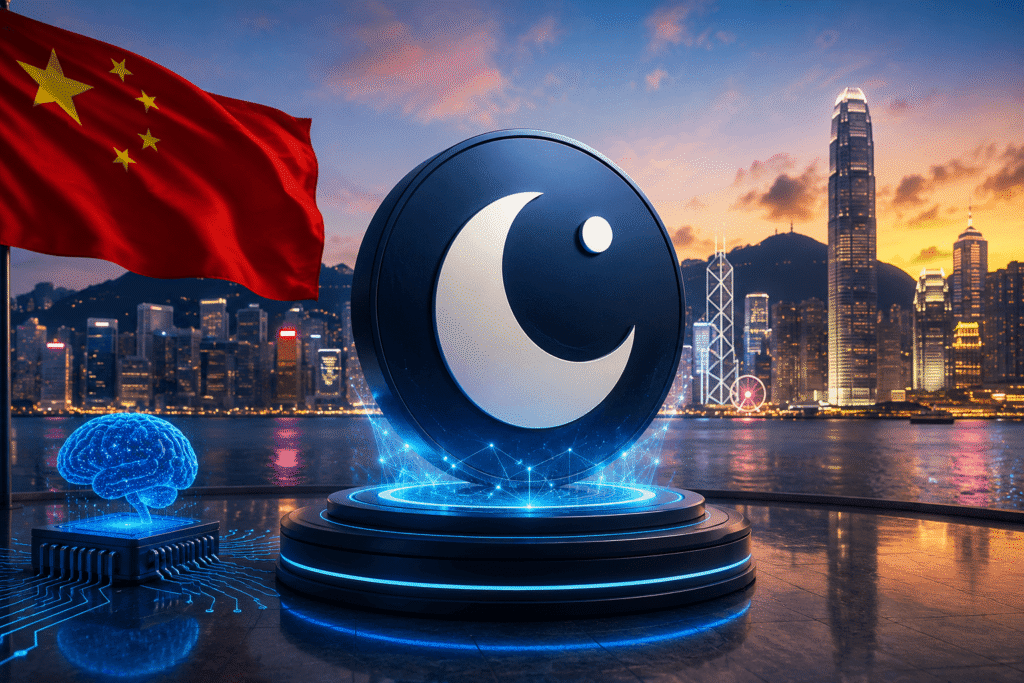
Chinese artificial intelligence startup Moonshot AI has confidentially filed for an initial public offering in Hong Kong, aiming to raise about $3 billion, according to Reuters. The Beijing-based company, best known for its Kimi large language model, is currently valued at approximately $50 billion in an ongoing private funding round.
If completed at that scale, the listing would rank among the largest Chinese AI companies to reach public markets, adding another major name to Hong Kong’s fast-recovering technology IPO pipeline.
The filing follows one of the sharpest valuation jumps in recent Chinese tech history — from roughly $4.3 billion to $50 billion in about a year — driven largely by the success of Moonshot’s newest AI model.
What Happened? Moonshot AI’s IPO Filing Explained
Moonshot has confidentially submitted IPO paperwork to Hong Kong’s exchange, according to three people familiar with the plans. Before filing, the company dismantled its offshore corporate structure and relocated its legal domicile to mainland China, a step two sources described as necessary preparation for the listing.
The company’s investor base includes Alibaba, Tencent, IDG Capital, and HSG (formerly Sequoia Capital China). In May, Moonshot raised more than $2 billion from backers including Meituan, China Mobile, and private equity firm CPE, bringing its total funding raised over its history to more than $5.5 billion. Moonshot is working with Goldman Sachs, China International Capital Corporation, and Deutsche Bank on the offering.
The valuation surge tracks closely with the mid-July release of Kimi K3, Moonshot’s flagship model, which reportedly uses 2.8 trillion parameters — making it one of the largest open-weight AI models available. Just a month before the IPO filing, Moonshot had closed a funding round at roughly $30 billion; the jump to $50 billion followed almost immediately.
Why It Matters
Moonshot’s IPO push is part of a broader pattern of Chinese AI labs turning to public markets for capital rather than relying solely on private funding rounds. Rivals Z.AI (formerly Zhipu) and MiniMax have already listed in Hong Kong this year, and DeepSeek is reportedly targeting a separate listing on Shanghai’s STAR Market with a valuation estimated between $71 billion and $74 billion.
The timing also reflects renewed strength in Hong Kong’s IPO market. Companies raised $41.2 billion through Hong Kong listings by mid-August 2026, up 142% from the same period a year earlier, according to LSEG data cited by Reuters. Chinese technology firms have driven most of that activity, and Hong Kong’s exchange reported that 511 listing applications were still under review as of August 31.
For the broader AI industry, Moonshot’s rise illustrates how quickly the competitive gap between US and Chinese AI labs has narrowed — at least in terms of investor enthusiasm and pricing power.
How It Works: Moonshot’s Business Model
Unlike many Chinese tech firms that have historically competed on price, Moonshot has taken a premium approach with Kimi K3, setting its API pricing at roughly 60% of what Anthropic charges for its Claude Opus models — but two to three times more expensive than domestic rivals such as Zhipu’s GLM-5.2. According to industry reporting, more than 70% of Moonshot’s revenue currently comes from API-driven services, suggesting the company has built a real commercial base rather than relying purely on hype.
Moonshot is also reportedly in early discussions with Microsoft, Amazon, and Google about potential revenue-sharing partnerships, which could extend Kimi’s reach into major global cloud platforms if finalized.
Key Benefits
Market validation: A successful IPO would confirm strong public investor appetite for Chinese AI companies.
Capital for growth: The estimated $3 billion raise would fund further model development and infrastructure expansion.
Global partnerships: Talks with major US cloud providers could widen Kimi K3’s distribution beyond China.
Boost for Hong Kong markets: A large AI listing would reinforce Hong Kong’s position as a hub for technology IPOs.
Risks and Challenges
Moonshot’s IPO ambitions face real regulatory headwinds. The company is reportedly under active investigation by the US Bureau of Industry and Security over allegations that it used restricted Nvidia processors — a probe that could complicate its international partnerships and investor confidence.
Analysts also note that Moonshot’s $50 billion valuation places it below rivals such as DeepSeek ($74 billion) and Z.AI ($66 billion), suggesting the market may be pricing Moonshot’s “sovereign strategic value” differently than pure commercial scalability. There is also the broader risk shared by all fast-growing AI labs: technology in this space moves quickly, and today’s flagship model can be overtaken within months.
Investors should treat any valuation figures as reflective of private funding rounds, not confirmed public market pricing, until the IPO is formally completed and priced.
What It Means for Businesses and Consumers
For businesses evaluating AI vendors, Moonshot’s rise adds another serious option to a market increasingly split between US labs (OpenAI, Anthropic, Google) and a growing cohort of well-funded Chinese developers (DeepSeek, Z.AI, Moonshot). Premium pricing suggests Moonshot is positioning Kimi K3 as a capability-first product rather than a budget alternative.
For everyday consumers, the more immediate effect may be indirect — increased competition in the AI model market tends to accelerate feature releases and, over time, can influence pricing across the industry, including for API-based tools consumers rely on indirectly through the apps they use.
What Happens Next?
Moonshot’s confidential filing is an early procedural step. The amount ultimately raised, and the timing of a public listing, will depend on regulatory approval and prevailing market conditions. Given the pace of recent developments — from a $30 billion valuation to a $50 billion IPO filing within about six weeks — further updates are likely in the coming months.
Key Takeaways
Moonshot AI has confidentially filed for a Hong Kong IPO targeting roughly $3 billion.
The company is valued at about $50 billion in its latest funding round, up from $30 billion a month earlier.
Kimi K3, released in mid-July 2026, is the primary driver behind the valuation surge.
Moonshot faces a US investigation into alleged use of restricted Nvidia chips.
The filing comes amid a broader boom in Hong Kong tech listings and rival Chinese AI IPOs.
Moonshot AI’s push toward a Hong Kong listing captures how fast China’s AI sector has matured in investor eyes — moving from private funding rounds to public markets in record time. Whether the company can justify a $50 billion valuation once it faces public shareholders, and how regulators respond to the ongoing chip investigation, will shape the next chapter of one of 2026’s most closely watched AI stories.