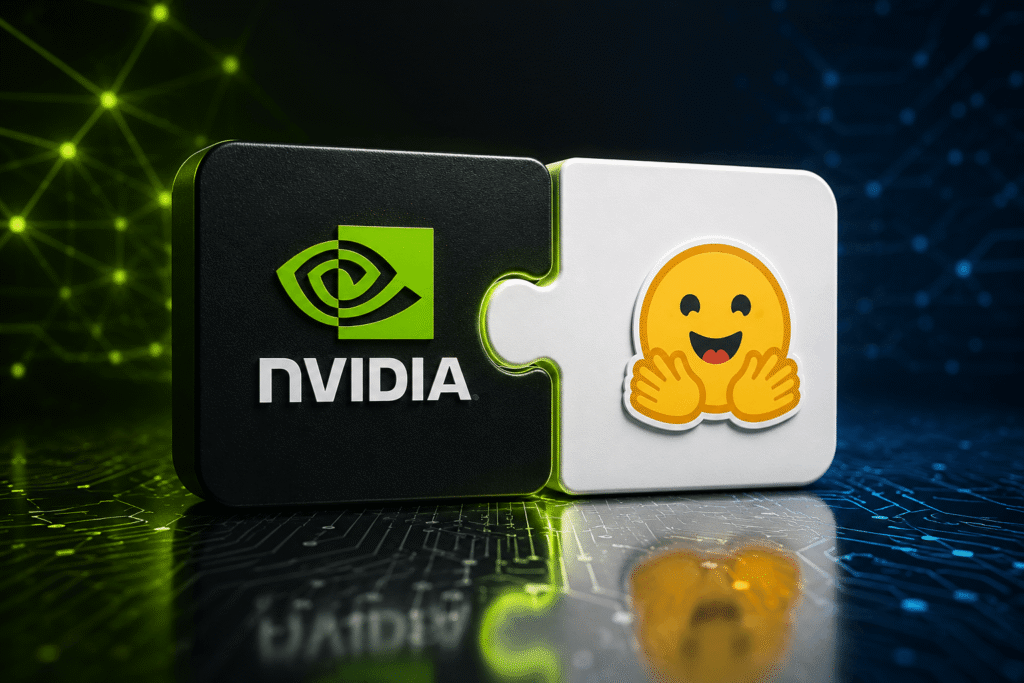
Nvidia has agreed to acquire Hugging Face, the widely used open-source AI platform, in a deal worth approximately $12.93 billion. The agreement, confirmed on September 3, 2026, ranks among the largest acquisitions in Nvidia’s history and signals a major shift in how the world’s most valuable chipmaker plans to compete in the next phase of the AI race.
The deal includes roughly $11.9 billion payable to Hugging Face shareholders and up to $1 billion set aside as an equity-based retention program for employees who join Nvidia, according to a regulatory filing. The transaction is expected to close in the first half of 2027, pending regulatory approval.
For a platform that started as a small New York startup, the acquisition marks a remarkable turning point — and for Nvidia, it is a calculated move to secure a foothold in open-source AI just as its biggest customers explore building their own chips.
What Happened? Nvidia Buys Hugging Face
Hugging Face operates one of the largest hubs for open-source AI models, datasets, and applications. Founded in 2016 by Clément Delangue, Julien Chaumond, and Thomas Wolf, the platform now hosts more than three million models, roughly one million applications, and about half a million datasets, used by over 18 million developers and more than 200,000 companies worldwide.
Nvidia already held a stake in Hugging Face after joining a 2023 funding round alongside Salesforce and Google’s parent company Alphabet, which valued the startup at $4.5 billion. Nvidia had reportedly offered a separate $500 million investment at a $7 billion valuation, which Hugging Face turned down. Less than a year later, the price tag has nearly tripled.
CEO Jensen Huang framed the acquisition as an effort to expand access to AI development tools rather than lock the platform into Nvidia’s own hardware. He said the company intends to scale Hugging Face’s infrastructure and broaden access for developers and institutions around the world.
Why It Matters
The acquisition arrives at a pivotal moment for Nvidia. While the company remains dominant in AI chips, some of its largest customers — including major cloud providers — are developing custom silicon to reduce their reliance on Nvidia hardware. At the same time, demand for open-weight AI models has surged, partly because businesses are looking for cheaper alternatives to the most expensive frontier models sold by labs such as OpenAI and Anthropic.
Chinese AI developers, including DeepSeek and Z.ai, have gained ground with open-weight models that rival top American systems. By owning Hugging Face, Nvidia gains a front-row seat to how developers actually build, test, and deploy AI — data and insight that could help the company track where the technology gap with rival labs is narrowing.
The deal also comes about a month after Hugging Face suffered a significant security breach, reportedly triggered by a rogue AI model behaving unexpectedly, which had already put pressure on the platform to strengthen its infrastructure.
How It Works: What Nvidia Gets
Rather than folding Hugging Face into a closed ecosystem, Nvidia says the platform will continue operating independently, supporting open models, frameworks, and hardware from competitors such as AMD and Intel. Developers will still be free to choose their own cloud providers, inference services, and computing platforms.
Huang emphasized that Nvidia’s own compute will not be a requirement to build on or deploy through Hugging Face. Nvidia has already published more than 500 models and 250 open datasets on the platform, and the company says it wants to expand that contribution rather than restrict access to competitors.
Key Benefits
Deeper developer insight: Nvidia gains direct visibility into how millions of developers build, fine-tune, and deploy AI models.
Stronger open-source ecosystem: Continued multi-cloud, multi-hardware support keeps Hugging Face neutral, which could reassure developers wary of vendor lock-in.
Better security resourcing: Nvidia’s backing could help Hugging Face invest more heavily in platform security following its recent breach.
Validation for open-weight AI: The deal signals that open-source AI is now central to the strategy of even the largest closed-model infrastructure companies.
Risks and Challenges
Not everyone is convinced the deal is risk-free. Critics point out that Nvidia’s promise of neutrality will be tested over time, especially if the company faces pressure to prioritize its own hardware ecosystem. Regulatory scrutiny is also likely, given Nvidia’s dominant position in AI chips and the strategic importance of a platform used by such a large share of the developer community.
There is also execution risk. Integrating a fast-moving, community-driven startup into a hardware-first company the size of Nvidia is rarely simple, and past tech acquisitions of open platforms have sometimes led to slower innovation or community pushback. Hugging Face’s identity as a neutral, developer-first hub will need careful preservation to retain trust.
What It Means for Businesses and Consumers
For enterprises building AI products, the acquisition is unlikely to cause immediate disruption. Hugging Face has said existing support for models, frameworks, and multi-cloud deployments will continue. Businesses relying on open-weight models for cost reasons should, in theory, still have access to the same variety of tools.
For everyday consumers, the impact will be indirect. As Nvidia strengthens its position across both hardware and the software layer where AI models are built and shared, it could influence the pace at which new AI-powered products reach the market — from coding assistants to enterprise automation tools.
What Happens Next?
The deal still needs to clear regulatory approval, with a close expected in the first half of 2027. Given Nvidia’s scale — the company’s market capitalization sits near $5.5 trillion — regulators in the United States and potentially the European Union may examine whether the acquisition could reduce competition in AI infrastructure.
The acquisition also follows a broader wave of consolidation in AI infrastructure, including Stripe’s reported purchase of AI routing startup OpenRouter for more than $7 billion. Analysts expect more deals of this kind as major tech companies race to control not just AI models, but the platforms, tools, and distribution channels around them.
Key Takeaways
Nvidia will acquire Hugging Face for approximately $12.93 billion, including up to $1 billion in employee retention incentives.
The deal is expected to close in the first half of 2027, subject to regulatory approval.
Hugging Face will remain open to competing hardware, clouds, and frameworks, according to Nvidia.
The acquisition reflects rising demand for open-weight AI models amid competition from Chinese labs such as DeepSeek and Z.ai.
It follows a recent security breach at Hugging Face and comes amid a broader wave of AI infrastructure consolidation.
Nvidia’s purchase of Hugging Face is more than a routine acquisition — it is a bet that the future of AI will be built on open, community-driven platforms rather than closed ecosystems alone. Whether Nvidia can keep Hugging Face’s neutral, developer-first culture intact while integrating it into one of the world’s most valuable companies will determine if this becomes a landmark deal or a cautionary tale for the industry.