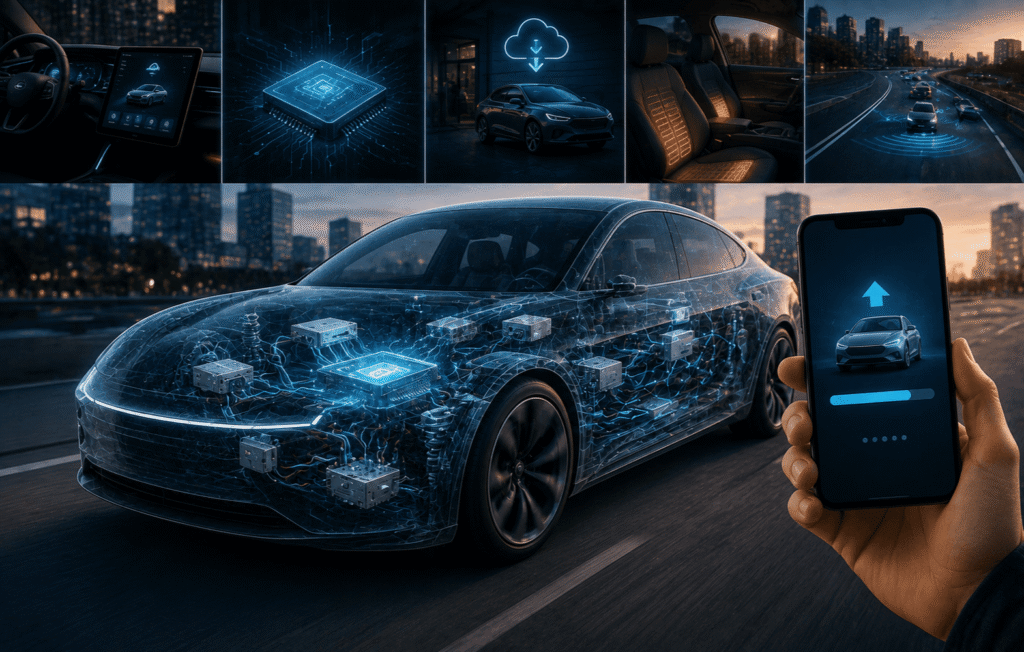
For most of the last century, a car was defined by its engine and its sheet metal, and once it left the factory it stayed roughly the same machine for its whole life. That is no longer true for a growing share of new vehicles. A software-defined vehicle separates most of a car’s features, from adaptive cruise control to seat heating profiles, into code that runs on a small number of powerful onboard computers, rather than dozens of separate hardware controllers wired together. The result is a car that can be updated, and sometimes upgraded, long after it leaves the dealership.
Why automakers are rebuilding around software
Traditional vehicles ship with 70 to 100 separate electronic control units, each running its own firmware for one narrow job like a window motor or a fuel injector. That architecture is expensive to design, slow to update, and nearly impossible to patch once a car is on the road. Centralizing that logic onto a handful of domain computers cuts manufacturing complexity and, more importantly, lets an automaker fix a bug or add a feature with an over-the-air update instead of a recall or a dealership visit. It also opens a new revenue line: features that used to be a one-time hardware option, like heated seats or extra horsepower, can now be sold as a subscription unlocked in software.
What changes for the driver
The most visible change is the update notification, the same kind of prompt a smartphone gives, arriving on a car’s dashboard. Beneath that, driver-assistance features are improving after purchase rather than staying frozen at the version installed on the assembly line, because the underlying perception and planning software can be retrained and pushed out remotely. Owners are also increasingly interacting with a car through an account rather than just a key, which brings smartphone-style convenience along with smartphone-style questions about data collection, subscription fatigue, and what happens to paid features when a car changes hands.
The hard part: security and reliability
A car that can be updated remotely is also a car that can be attacked remotely, which is why automakers making this shift are investing heavily in the same kind of security practices software companies use: signed updates, isolated critical systems, and the ability to roll back a bad release. Safety-critical functions like braking and steering are typically kept on separate, more conservative software paths than infotainment or comfort features, precisely so that a bug in a less critical system cannot cascade into one that matters for physical safety.
Where this is heading
The software-defined approach is becoming close to a requirement for automakers competing on autonomous driving features, since those systems depend on constant retraining and redeployment that a fixed hardware architecture cannot support. It is also changing who competes in the auto industry, since a company’s software and update infrastructure now matters as much to a buyer’s experience as its engine or chassis engineering once did. For buyers, the practical takeaway is that a car purchased today is increasingly a starting point rather than a finished product, one that keeps changing for as long as the manufacturer keeps supporting it.