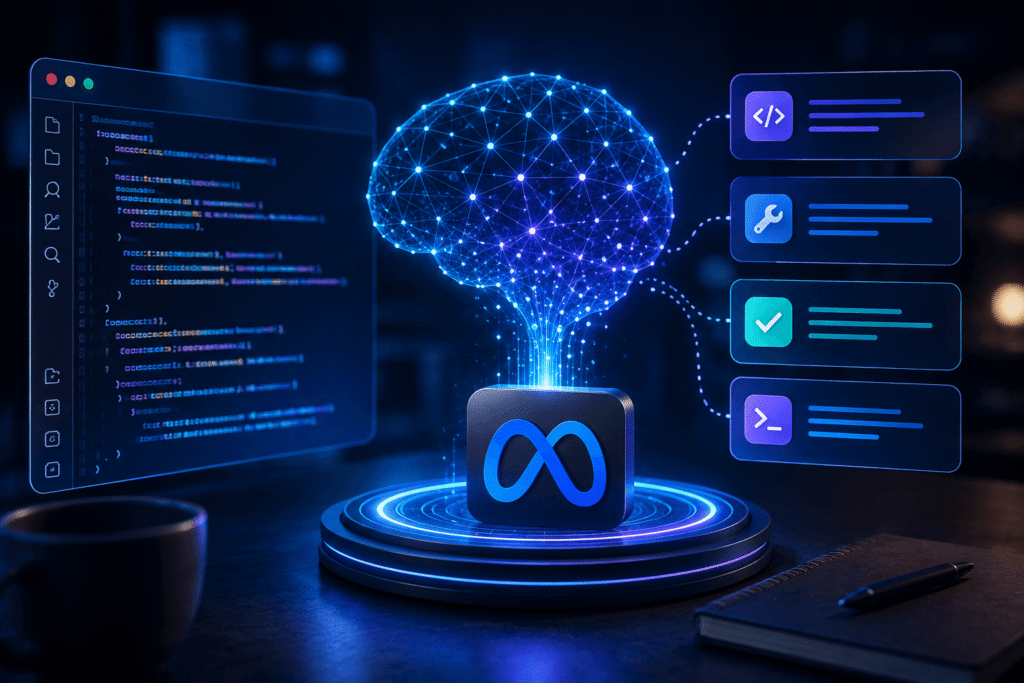
Meta released Muse Spark 1.3 on September 2, 2026, the newest model from Meta Superintelligence Labs, rolling it out simultaneously in Muse Code and the Meta Model API. The update focuses on improving performance across coding and agentic tasks — AI workflows where a model plans, executes, and adjusts multi-step actions with limited human oversight.
The release builds on months of real-world use of Muse Code and the Meta Model API, according to Meta, and arrives as competition intensifies among AI labs racing to build models capable of handling longer, more complex tasks with less supervision.
What Happened? Meta’s Muse Spark 1.3 Release Explained
Muse Spark 1.3 is available now under the model ID muse-spark-1.3 through Meta’s Model API, priced at $1.25 per million input tokens and $4.25 per million output tokens. It supports a context window of roughly 1.05 million tokens, with a maximum output of about 131,000 tokens, and includes vision, multimodal, reasoning, and tool-use capabilities.
According to Meta, the model’s previously available reasoning modes are ready at launch, while a “max reasoning” mode is expected shortly, pending additional safety testing. Meta pointed users to an accompanying evaluation report for detailed benchmark comparisons rather than publishing every figure in its main announcement.
Muse Spark 1.3 follows Muse Spark 1.2, which powered the beta version of Muse Code — Meta’s coding agent — released in August 2026. That earlier version introduced the ability to split large coding tasks across multiple parallel sub-agents working in isolated Git environments, a feature Meta says continues to underpin Muse Code today.
Why It Matters
Muse Spark 1.3 represents Meta’s continued shift away from the fully open-source Llama models that once defined its AI strategy. Since forming Meta Superintelligence Labs and launching the original Muse Spark model, Meta has kept its newest frontier-adjacent models closed, deploying them directly across its own products — including the Meta AI app, and eventually Facebook, Instagram, WhatsApp, Messenger, and its wearable devices — rather than releasing the weights publicly.
This release also reflects a broader industry trend: AI labs are increasingly optimizing not just for raw intelligence, but for models that can sustain long, messy, real-world tasks over extended sessions without losing track of instructions or context — a capability gap that has limited how much businesses can actually trust AI agents with complex work.
How It Works: What’s New in Muse Spark 1.3
Meta says Muse Spark 1.3 is designed to sustain longer-horizon work by collaborating with users across a single, extended thread rather than requiring tasks to be broken into disconnected sessions. When given an open-ended objective, the model reportedly generates its own context from messy or conflicting sources, proactively identifies gaps in its plan, and tracks what it has learned throughout the task to produce a final deliverable.
The model was trained across a range of different task environments, or “harnesses,” which Meta says helps it generalize better across varied agentic settings rather than performing well only in narrow, tested scenarios.
Meta also emphasized changes aimed at making the model easier to work alongside: Muse Spark 1.3 is trained to ask clarifying questions when a prompt is ambiguous, request help from the user when it gets stuck, and confirm before taking consequential or hard-to-reverse actions. On longer tasks, Meta says the model adapts to user preference — either providing frequent progress updates or working quietly in the background until it has something meaningful to report.
Meta also said the model follows complex, long-form instructions more reliably than earlier Muse Spark versions, better preserving detailed requirements across multi-step tasks without dropping constraints along the way.
Key Benefits
Better long-task reliability: Improved instruction-following reduces the risk of an agent drifting from its original requirements over a long session.
More collaborative behavior: Built-in clarifying questions and confirmation steps aim to reduce costly mistakes from AI agents acting on unclear instructions.
Competitive pricing: At $1.25/$4.25 per million input/output tokens, Muse Spark 1.3 is positioned as a lower-cost alternative to some larger frontier coding models.
Large context window: A roughly 1.05 million token context window allows the model to work with large codebases or lengthy documents in a single session.
Risks and Challenges
Because Muse Spark 1.3 is a closed model, independent researchers cannot inspect its weights or fully verify Meta’s performance claims the way they could with an open-source release — a notable shift from Meta’s earlier Llama strategy, which built goodwill in the open-source AI community.
The delayed rollout of “max reasoning” mode, pending further safety testing, also signals that Meta is still working through how much autonomy to grant the model on its most demanding tasks. Long-horizon agentic models in general carry real operational risk: a model that acts across many steps without close supervision can compound small errors into larger ones before a human notices, which is part of why Meta has built in confirmation steps for consequential actions.
Businesses adopting Muse Spark 1.3 for coding or automation should also weigh the earlier reports around Muse Code’s predecessor, Muse Spark 1.2 — including Meta’s own, not yet independently verified, claims about running over 1,000 tool calls in 24 hours during internal testing.
What It Means for Businesses and Consumers
For software teams, Muse Spark 1.3 offers another option in the fast-growing market for AI coding agents, competing directly with tools built on rival models from OpenAI, Anthropic, and Google. Its emphasis on sustaining long, multi-step tasks could appeal to teams looking to automate larger chunks of development work, provided they’re comfortable with a closed, proprietary system.
For consumers, the more visible impact will come through Meta’s own products. As Muse Spark 1.3 and future versions roll out across Meta AI, Instagram, WhatsApp, and Messenger, everyday users may notice more capable AI features embedded directly into apps they already use daily.
What Happens Next?
Meta has said “max reasoning” mode for Muse Spark 1.3 will follow shortly, once additional safety testing is complete. Given Meta’s recent release pace — moving from Muse Spark 1.1 in July to 1.2 in August and 1.3 in September — further iterative updates are likely in the coming months as Meta Superintelligence Labs continues refining its agentic and coding capabilities.
Key Takeaways
Meta released Muse Spark 1.3 on September 2, 2026, available in Muse Code and the Meta Model API.
Pricing is set at $1.25 per million input tokens and $4.25 per million output tokens.
The model supports a roughly 1.05 million token context window and focuses on long-horizon agentic and coding tasks.
Muse Spark 1.3 is trained to ask clarifying questions and confirm before taking consequential actions.
A “max reasoning” mode is expected soon, pending further Meta safety testing.
Muse Spark 1.3 shows Meta doubling down on agentic AI as its core strategic bet, prioritizing models that can reliably handle long, complex tasks over models that are simply open for anyone to inspect. As the model rolls out further across Meta’s own apps, its real test will be whether it can sustain trust on the kind of long, high-stakes tasks businesses are increasingly asking AI agents to handle.